
Digital Signage vs Audio Networks: Which Drives More Sales?
Compare digital signage and in-store audio networks—sales uplift, recall, footfall and trade-offs, plus why combining both increases retail performance.
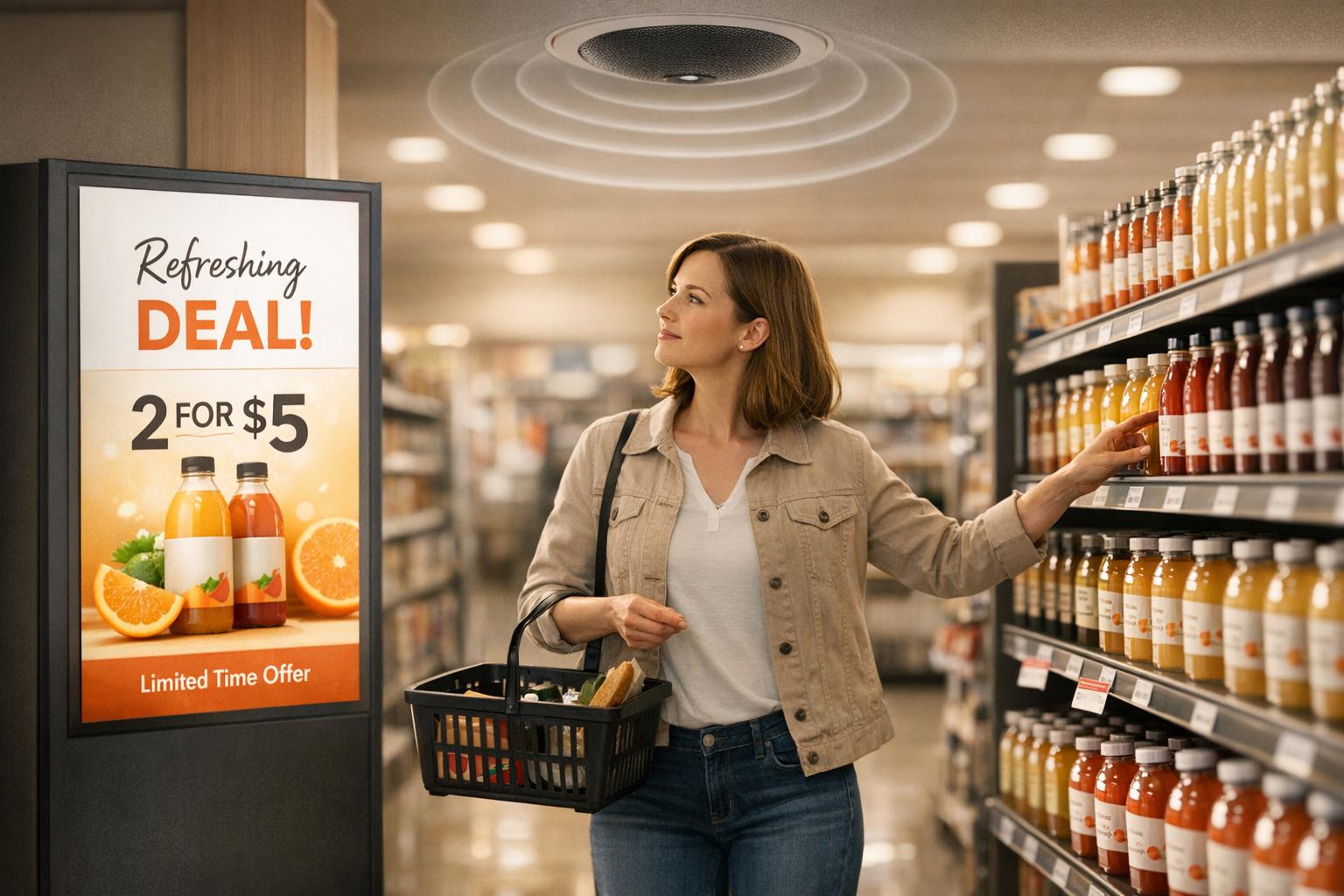
Digital Signage vs Audio Networks: Which Drives More Sales?
Which works better for sales: digital signage or audio networks?
Both are highly effective tools for influencing shopper behaviour in Australian retail stores, but they work in different ways. Digital signage grabs attention with dynamic visuals, boosting sales by an average of 8.1% and achieving recall rates of 83%. Audio networks subtly guide shoppers through in-store journeys, with 73% of listeners purchasing advertised products or similar items and 76% locating the product after hearing an ad.
Key Findings:
- Digital Signage: Best for visual engagement, product demos, and impulse buys. Effective for younger shoppers (79% of Gen Z notice screens).
- Audio Networks: Ideal for subtle influence, product discovery, and driving immediate action. Reaches all shoppers, with 20.3% average sales lift in campaigns.
Quick Comparison:
| Feature | Digital Signage | Audio Networks |
|---|---|---|
| Sales Uplift | 8.1% to 33% | 73% purchase rate for heard ads |
| Recall Rate | 83% | Strong auditory recall |
| Best Use Case | New product launches, demos, visuals | Product discovery, subtle guidance |
| Cost | Higher upfront (e.g., $18,000 setup) | Lower; uses existing speaker systems |
Both mediums are effective, but combining them creates a multi-sensory experience that can significantly improve sales. The choice depends on your retail goals and customer interaction preferences.
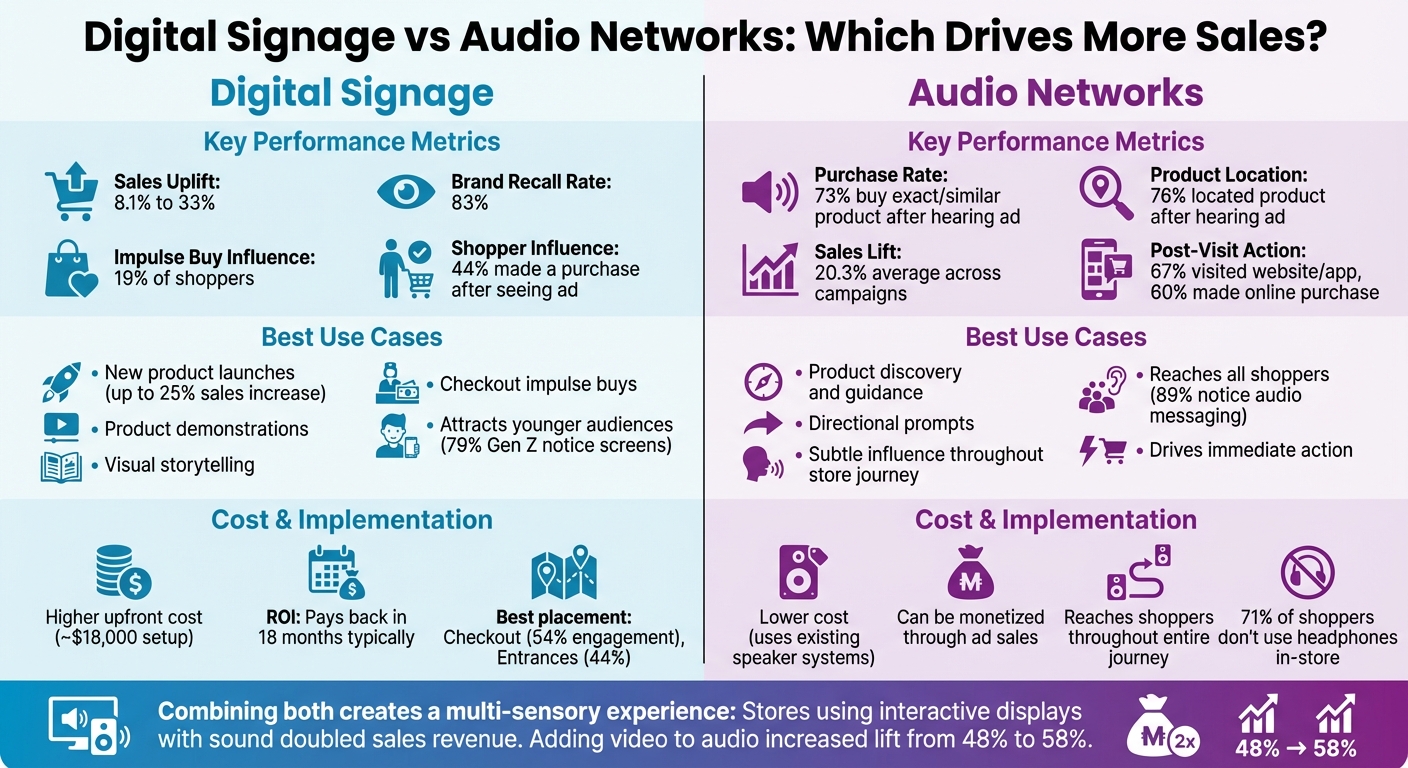
Digital Signage vs Audio Networks: Sales Impact and Performance Comparison
How In-Store Retail Media is Transforming with Personalized Digital Signage
sbb-itb-c231c83
How Digital Signage Affects Retail Sales
Digital signage has a noticeable impact on how shoppers behave and make purchasing decisions. Take Toyota of Berkeley as an example: they installed 11 digital screens in various areas of their dealership, spending $18,000. Within just 90 days, their closing ratios jumped from 18% to 24% - a 33% improvement. On top of that, they saw an increase of $420 in profit per vehicle sold. The system paid for itself in under a month and delivered an impressive 314% return on investment over 12 months.
"The screens turned our showroom into a 24/7 sales assistant. Even when our team is busy, customers stay engaged and educated".
Digital signage also enhances the "Halo Effect", encouraging customers to buy more than just one item. This is especially effective for impulse buys and works even better during specific times - like late shopping hours when decision-making weakens, on weekends when people are more relaxed, or in busy stores where eye-catching visuals cut through the noise.
Sales Metrics for Digital Signage
A four-year study conducted by Babson College and VU Amsterdam, presented at the NRF conference in January 2026, analysed 237 advertising campaigns and 30 million shoppers. The findings were clear: digital signage increases purchase likelihood by an average of 8.1%. For new product launches, the boost can be as high as 25%. Quick-service restaurants using digital menu boards report that these displays account for about 20% of total order volume.
The effectiveness of digital signage is also reflected in its 83% recall rate, far exceeding the roughly 50% recall rate of static posters. Additionally, its advertising elasticity of 0.18 is 50% higher than the benchmark for brand advertising, meaning every dollar spent on digital signage delivers more impact.
| Display Location | Shopper Notice Rate |
|---|---|
| Checkout Areas | 54% |
| Store Entrances | 44% |
| Shelf/Aisle Displays | 42% |
Switching from printed materials to digital signage can lead to up to 32% sales growth and 35% cost savings. For example, one quick-service restaurant chain replaced printed menu boards with digital screens that updated menus based on the time of day and included automated upselling prompts. The result? A 3% to 5% increase in sales per store, along with 30% to 50% lower printing costs.
These statistics highlight how digital signage delivers measurable outcomes across different retail settings.
Benefits of Digital Signage
Visual engagement is one of digital signage’s strongest assets. Unlike static posters, screens grab attention, especially among younger audiences - 79% of Gen Z and 75% of Millennials notice in-store displays, compared to only 29% of Baby Boomers. Interactive features, like virtual try-ons or customisation options, take this further. In fact, 80% of shoppers are more likely to buy when offered a personalised experience.
Dynamic content adaptability allows retailers to adjust messaging instantly. For instance, you can schedule specific promotions for late afternoons or weekends when shoppers are more likely to convert. Similarly, screens can promote cold drinks on hot days or umbrellas when rain is expected. Emotional or inspirational content can further boost conversions by 11% to 12% compared to purely informational messages.
Advanced analytics integration turns digital signage into a powerful tool for tracking revenue. By connecting your content management system (CMS) to Point-of-Sale systems, you can directly attribute sales to screen exposure. Technologies like computer vision and sensors can monitor foot traffic and adjust content in real-time based on shopper demographics. Digital signage also increases customer dwell time by 30%, and in places like banks or car dealerships, it reduces perceived wait times by 25% to 30%.
Drawbacks of Digital Signage
Screen fatigue is a common issue when customers repeatedly see the same content loop. Around 37% of retailers report that "content fatigue" affects their return on investment. The solution? Refresh visuals at least every two weeks to keep things fresh and engaging.
Higher upfront costs can be another hurdle. A mid-sized installation typically costs around $18,000, including hardware, installation, and the first year of CMS subscription. While most systems pay for themselves within 18 months, the initial expense is still significantly higher than printing static posters.
Attribution challenges make it tricky to measure the true impact of digital signage. For instance, a customer might see an ad in-store but complete their purchase online, making it difficult to credit the screen for the sale. Additionally, integrating signage data with POS systems can be technically complex, especially for retailers without dedicated IT support.
These considerations provide a solid foundation for comparing digital signage with other in-store technologies, like audio networks.
How Audio Networks Affect Retail Sales
Audio networks, unlike digital screens, connect with shoppers throughout their entire in-store journey. Whether they're browsing aisles, waiting at checkout, or even trying on clothes, customers are exposed to promotional messages. This "captive audience" approach has a measurable impact: 89% of consumers notice in-store audio messaging, and 48% say it influences them to seek out and consider specific products. These figures highlight audio's potential to drive sales in retail settings.
Audio's influence often works subtly. For example, the tempo of background music can align with shoppers' movements: slower music encourages customers to linger, while faster beats increase the pace of foot traffic. Research shows that shoppers spend 17% more time in stores with slow-paced music, with some supermarkets reporting sales increases of up to 38% as a result. Even the type of music matters - French tunes in a wine shop led to French wine outselling German wine at a 5:1 ratio, while German music reversed the trend.
In a notable study from June 2024, Stingray Advertising and Nielsen Scantrack analysed data from 21,100 U.S. stores across 42 product categories. By comparing stores with in-store audio campaigns to those without, they found an average sales increase of 20.3%, with allergy remedies seeing a 24.9% boost.
"With an average sales lift of 20.3%, our targeted in‑store advertising solutions not only enhance brand visibility but also drive substantial revenue growth for our partners." - Bryan McGuirk, CRO, Stingray Advertising
This impact isn't limited to in-store purchases. After hearing an audio ad, 76% of shoppers found the advertised product, and 73% went on to buy it or a similar item. Additionally, 67% visited the retailer's website or app, and 60% eventually made an online purchase. In Australia, Nine and Azira collaborated in 2025 on a digital audio campaign for a pharmacy retailer, using short ads to promote weekly deals. The results? A 36% increase in foot traffic and a 20% higher preference for value-driven brands among the exposed audience.
Sales Metrics for Audio Networks
The data paints a compelling picture of audio's role in driving retail sales. On average, in-store audio campaigns deliver a 20.3% sales lift across consumer packaged goods. Unlike visual media, which depends on shoppers actively looking at screens, audio messaging continuously reaches customers. In fact, 58% of shoppers who recall hearing an audio ad make a purchase, and 71% of shoppers rarely use headphones in-store, making them naturally receptive to these messages.
Studies back up these findings. The Stingray research controlled for factors like pricing and seasonal trends to isolate audio's true effect, showing consistent results across categories such as health, beauty, and snacks. Similarly, Azira's campaign for an Australian pharmacy used location-based data to track increased foot traffic, confirming that audio's influence extends beyond immediate purchases. These metrics underline audio's ability to enhance retail performance.
Benefits of Audio Networks
One of audio's biggest strengths is its subtle influence. Unlike screens, which demand attention, music and messaging work in the background, shaping customer behaviour without being intrusive. For instance, classical music in luxury stores encourages higher-value purchases, while country music promotes practical buying decisions.
Audio networks are also cost-efficient. Most stores already have speaker systems, so costs mainly involve managing content rather than installing new hardware. Cloud-based platforms add flexibility, allowing retailers to update messaging in real time. This prevents promoting out-of-stock items and ensures ads stay relevant.
Retailers can also monetise audio networks by selling ad space to brands. This transforms in-store audio into a revenue stream, with ads tailored to local demographics like age, gender, or lifestyle. Messages can be strategically placed between songs to maintain a pleasant shopping atmosphere.
"In competitive environments like grocery, convenience stores or big-box retailers... audio in‑store can make the difference in what items people choose." - Paul Brenner, President of Audio OOH, Vibenomics
Drawbacks of Audio Networks
Despite its advantages, audio networks come with challenges. Volume control is critical - while younger shoppers might prefer louder, upbeat music, older customers often favour softer background audio. Poor volume management can irritate customers instead of engaging them. Sound quality is another concern, especially in stores with hard surfaces like glass or tile, where audio may echo or overlap between areas.
Tailoring messages to diverse audiences can also be tricky. Nearly half of shoppers are in a rush and respond best to short, straightforward messaging. However, this approach might not resonate with more relaxed weekend shoppers, requiring retailers to carefully balance content for different times and audiences.
Finally, proving return on investment (ROI) can be complex. While studies like those from Stingray provide valuable insights, they require advanced data analysis and third-party collaboration. Smaller retailers may lack the resources for such studies, relying instead on anecdotal feedback. Tracking the full customer journey - from hearing an audio ad to completing an online purchase - often demands integrating multiple data sources, which can be a hurdle for some businesses.
Digital Signage vs Audio Networks: Direct Comparison
When deciding between digital signage and audio networks, retailers need to consider their specific goals and how customers interact with their store environment. Digital signage excels at delivering visual product demonstrations, while audio networks are better suited for influencing shopper behaviour through auditory cues.
Digital signage can boost sales by an average of 8.1% across retail spaces, with new product launches seeing increases of up to 25%. On the other hand, audio networks are particularly effective for driving purchases, with 73% of shoppers buying the exact or a similar product after hearing an audio ad.
Performance Metrics Compared
| Metric | Digital Signage | Audio Networks |
|---|---|---|
| Average Sales Uplift | 8.1% to 33% | 73% purchase rate for heard ads |
| Brand Recall Rate | 83% | 8× increase (when audio-aligned) |
| Impulse Buy Influence | 19% of shoppers | 73% purchased exact/similar item |
| Shopper Influence | 44% made a purchase after seeing an ad | 76% located the product after hearing an ad |
| Post-Visit Action | QR code scans and brand recall | 67% visited website/app; 60% made an online purchase |
Engagement Methods Compared
| Feature | Visual Engagement (Digital Signage) | Auditory Engagement (Audio Networks) |
|---|---|---|
| Pros | High recall rates (83%); ideal for product demos; attracts younger audiences (79% Gen Z); strong engagement at decision points like checkouts (54%). | Reaches all in-store shoppers; encourages immediate actions; creates strong links to digital channels. |
| Cons | Requires visibility; less effective with older demographics (29% Baby Boomers); impact depends on placement. | No visual element; can feel intrusive if volume or frequency isn’t managed well. |
| Best Use Case | Perfect for new product launches, brand storytelling, checkout impulse buys, and high-margin indulgent items. | Works best for directional prompts, item-specific promotions, app integrations, and guiding customers to product locations. |
By understanding these differences, retailers can make informed decisions on how to use these tools effectively. Advanced systems like Adflux CMS are now helping businesses combine the strengths of both networks to create more impactful in-store experiences.
"Digital signage yields an advertising elasticity of 0.18 - which is 50% higher than benchmark brand advertising elasticities." - Retail Media World
Using Adflux CMS to Manage Both Media Networks
Handling separate networks for visual and auditory media can be a logistical headache. Adflux CMS simplifies this by bringing both media types together on a single cloud-based platform. This unified system allows retailers to manage screens and speakers across multiple locations from one interface, streamlining operations and improving campaign execution.
One standout feature is the platform's scheduling tool, which lets you plan content months in advance. Instead of manually updating screens or audio zones daily, you can group displays by region and deploy campaigns across hundreds of locations with just one click. For instance, if you're running a weekend sale across Victorian stores, you can push the promotion to all grouped screens simultaneously, saving time and effort. This scheduling capability also opens the door to further automation through API integration.
With API integration, Adflux CMS connects directly to inventory databases, automatically pausing ads for products that are out of stock. This prevents customer disappointment and avoids wasting valuable screen time. The platform also supports programmatic monetisation, allowing unused airtime to be sold through automated ad marketplaces. This creates additional revenue streams without increasing administrative workload.
Another key feature is remote monitoring, which provides real-time updates on screen connectivity and displays. This means you can troubleshoot issues remotely without needing to send staff to the site. The platform also offers multi-user permissions, enabling marketing teams to handle content creation while allowing store managers to control what appears in their specific locations. This level of unified control helps optimise the performance of in-store media.
"Adflux CMS is not a one-size-fits-all solution - it's purpose-built for the unique demands of in-store retail media." - Adflux
Case Studies and Results
Real-world examples show how digital signage and audio networks can significantly boost retail performance.
QuickStop Markets in the United States installed 2,870 digital displays across 287 convenience stores in June 2024. These displays, positioned on fuel pump toppers, encouraged add-on purchases with messages like, "Add a coffee for $0.99 - you're already here." The results were striking: the average basket size jumped from $7.40 to $9.92 - a 34% increase. Coffee attachment rates rose from 18% to 34%, while hot food purchases climbed from 12% to 28%. Chief Marketing Officer David Chen explained:
"Every display is a silent salesperson highlighting deals, suggesting add-ons, and creating urgency. Our basket size is up 34%, promotional items are flying off shelves."
While digital displays are effective at increasing basket sizes, audio campaigns excel in driving foot traffic and immediate action. In February 2026, Australian media company Nine launched a digital audio campaign for a major pharmacy retailer. Featuring 15- and 30-second ads promoting weekly deals, the campaign led to a 36% rise in foot traffic to physical stores. Offline attribution tracking confirmed the success of this value-driven messaging.
Another example highlights the precision and financial impact of audio networks. In September 2024, Katz Digital ran a geo-targeted audio campaign for a Big Box retailer. Ads promoted both name-brand and private-label products, resulting in $3 million in attributed consumer spend, a 12:1 return on ad spend, and an 8% increase in new customers. This demonstrates how targeted audio campaigns can drive immediate conversions and boost revenue.
Conclusion: Choosing the Right Medium for Your Store
Deciding between digital signage and audio networks isn’t a straightforward choice - it depends on factors like your store type, target customers, and sales objectives. Digital signage, for example, delivers an average 8.1% sales boost, making it ideal for grocery stores, electronics retailers, and apparel shops. Its ability to engage younger audiences makes it especially effective for launching new products, with sales increases reaching up to 25%.
On the other hand, audio networks excel at encouraging immediate product discovery. According to research, 76% of shoppers who hear in-store audio ads locate the product, and 73% of them complete a purchase. Additionally, 67% of those listeners visit the retailer’s website or app later, proving audio's value in an omnichannel marketing strategy.
Combining the strengths of both mediums can create a powerful multi-sensory retail experience. For instance, pilot tests revealed that stores using interactive displays with sound doubled their sales revenue compared to those without any point-of-sale media. Adding video to sound-enabled displays further elevated the sales lift from 48% to 58%.
To streamline management, tools like Adflux CMS make it easier to oversee both networks. This centralised platform allows you to synchronise visual and audio campaigns across multiple locations, automate updates based on real-time inventory, and utilise data-driven targeting - all from a single dashboard.
Placement and content are also key to maximising impact. Position digital signage in high-traffic areas like checkout zones (54% engagement) and store entrances (44%). Focus on practical content, such as price comparisons and live promotions, rather than purely decorative visuals. For audio, vary the playlist to avoid listener fatigue. As Fergal Ó Ceallaigh, CEO of Ryarc, notes:
"If you play three Elton John and five others in a retail setting, employees may become frustrated with repetitive audio".
FAQs
Which option suits my store goals best?
When it comes to increasing sales, digital signage and audio networks each offer distinct advantages, depending on what you're aiming to achieve.
Digital signage shines when it comes to grabbing attention visually. It’s especially effective at encouraging impulse buys and boosting sales of specific products. In fact, research shows it can lead to an average sales increase of 8.1% - a solid result for businesses looking to make a visual impact.
On the other hand, audio networks are all about setting the mood. They can shape the overall atmosphere of a space while also reinforcing promotional messages. Interestingly, 73% of shoppers say they’re influenced by in-store audio, making it a powerful tool for guiding customer behaviour.
For the best results, why not combine the two? Together, they can create a dynamic, immersive shopping experience that grabs attention and leaves a lasting impression.
How do I measure ROI from in-store media?
To gauge the ROI of in-store media like digital signage and audio networks, it's crucial to monitor a few key metrics. For digital signage, pay attention to impressions, dwell time, and sales growth. When it comes to audio networks, focus on metrics such as purchase intent and post-exposure behaviour.
To evaluate performance and make improvements, use tools like CMS analytics, camera counting systems, and A/B testing. These methods can help you understand the impact of your media efforts and fine-tune them for better results.
What’s the best way to combine screens and audio?
The most effective way to merge screens and audio in retail is by taking a multi-sensory approach. By syncing digital displays with audio elements - whether it's music, voiceovers, or promotional messages - you can craft a seamless and engaging experience for customers.
This pairing grabs attention visually while reinforcing your message through sound. The result? Increased customer engagement, longer browsing times, and potentially higher sales. When done right, screens and audio complement each other to amplify the power of your in-store marketing.
Adflux Editorial
Retail media, programmatic DOOH, and digital signage insights for Australian retailers.
Ready to build your retail media network?
Talk to the Adflux team about how the platform can work for your screens.