
What Is Enterprise-Grade Governance in Retail Media?
Enterprise-grade governance prevents data errors, enforces privacy compliance and delivers reliable closed-loop measurement and ROI for retail media networks.

What Is Enterprise-Grade Governance in Retail Media?
Enterprise-grade governance in retail media is a system of policies, tools, and standards designed to manage data, compliance, and operations in retail media networks. It ensures accurate measurement, data security, and smooth operations across e-commerce, loyalty programs, and in-store platforms. This approach addresses key challenges like fragmented data, compliance risks, and inefficient processes, which can cost Australian retailers up to A$13 million annually.
Key takeaways:
- Purpose: Proactively prevent errors, manage data, and ensure compliance.
- Core Areas: Advertising content, data security, and closed-loop measurement.
- Benefits: Improved trust, accountability, and profitability.
- Challenges: Complex programmatic advertising and scaling operations.
- Tools: Platforms like Adflux CMS streamline governance with real-time updates, reporting, and privacy-focused analytics.
As retail media grows in Australia, with the market expected to reach A$3 billion by 2027, enterprise-grade governance is essential for maintaining competitive advantage and building trust with advertisers.
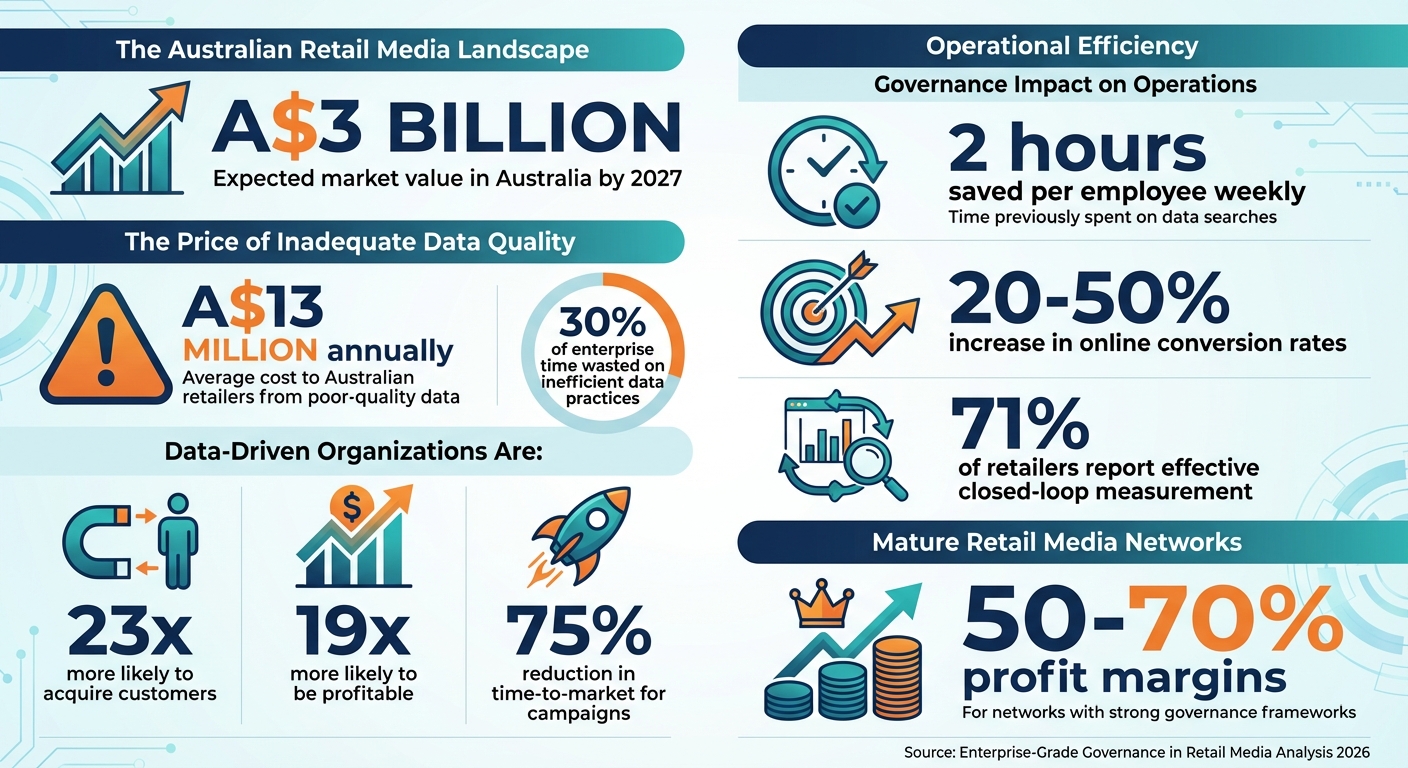
Enterprise-Grade Governance in Retail Media: Key Statistics and Benefits
Retail Media Networks Grow in Predictable Stages - and Each One Has a Trap
sbb-itb-c231c83
What Is Enterprise-Grade Governance in Retail Media?
Enterprise-grade governance in retail media refers to a strategic system of policies, roles, and automated processes designed to maintain the accuracy, security, and compliance of advertising content and shopper data across a retail network. Unlike standard governance, which often focuses on reporting after campaigns are completed, enterprise-grade governance acts as a proactive control layer. It prevents issues before they arise, making it indispensable in automated environments where even minor errors can quickly snowball into significant financial losses.
This approach also creates a "single version of truth" for product details and customer identities, eliminating the chaos caused by mismatched records across systems like PIM, CRM, and CMS. The benefits are clear: data-driven organisations are 23 times more likely to attract new customers and 19 times more likely to achieve profitability. These statistics highlight the critical role governance plays in driving business success.
Governance in Retail Media Explained
Governance in retail media focuses on three key areas: advertising content, data security, and compliance. A standout feature is its emphasis on "closed-loop" measurement, which ties ad impressions directly to transactions using first-party data. This level of accountability is something traditional digital advertising often lacks.
The framework is designed to handle the complexities of multi-channel environments, including onsite, offsite, and in-store channels. For instance, 71% of retailers report their networks as very or extremely effective in conducting closed-loop measurement. However, this effectiveness hinges on robust governance. Without it, retailers risk losing an average of A$13 million annually due to poor-quality data.
Daniel Lim, a Digital Ad Specialist at Louder, summarises the shift in mindset:
Performance is no longer something teams simply optimise. It's something they govern.
This shift makes measurement and ad tech tagging integral to marketing systems, not just afterthoughts. Governance also ensures dynamic consent management across platforms, reducing the risk of compliance breaches that could derail campaigns.
How Governance Improves Network Management
Governance frameworks help streamline operations by enforcing consistent standards for naming, formatting, and validation across merchandising, engineering, and marketing teams. This consistency is critical when managing thousands of digital assets and screens simultaneously.
The efficiency gains are tangible. Employees can save up to two hours each week that would otherwise be spent searching for accurate product data. Additionally, brands using Customer Data Platforms with strong governance have seen a 75% reduction in time-to-market for marketing campaigns. These improvements directly enhance profitability.
As retail media networks expand to offsite channels like connected TV and social media, governance ensures proper use of first-party data while maintaining privacy compliance. This leads to faster integrations, reduced technical debt, and smoother data flows - all essential for large-scale networks. With these efficiencies in place, the next sections will explore how governance supports compliance, data security, and content quality.
Core Components of Governance Frameworks
A solid governance framework in retail media is built on three key pillars: compliance with regulations, data security and privacy protection, and content quality standards. These elements ensure that automated bidding and targeting operate on reliable data sources. In automated systems, even minor configuration errors can quickly lead to financial losses.
The Independent Media Agencies of Australia (IMAA) identifies critical aspects like privacy by design, ethical audience targeting, transparency in the digital supply chain, vendor accountability, and audit readiness. Meanwhile, IAB Australia's framework highlights five principles: Transparency & Consistency, Accuracy & Reliability, Shopper Centricity, Privacy & Security, and Compliance with industry standards. Together, these frameworks establish a control layer for programmatic platforms, shaping behaviours and outcomes in the retail media space.
Compliance and Regulatory Requirements
Governance in retail media starts with meeting regulatory requirements. In Australia, the Office of the Australian Information Commissioner (OAIC) provides guidance on the Privacy Act 1988 and the Australian Privacy Principles (APPs), which are treated as legally binding interpretations rather than optional advice. Privacy has now become a board-level concern.
The upcoming Tranche 2 reforms to the Privacy Act will introduce a "fair and reasonable" test. This will require businesses to prove that their data practices - like lookalike modelling or clean room operations - genuinely benefit individuals, even if consent was previously obtained. Privacy Commissioner Carly Kind noted:
"We're certainly not sitting around waiting for tranche two… I've got a pretty clear-eyed vision of how to achieve some of the same ends through quite robust enforcement."
Since late 2024, the OAIC has conducted proactive compliance scans on tracking pixels, loyalty programs, and geo-targeting to establish benchmark enforcement cases. Retailers must now audit their tech stacks regularly, ensuring every pixel, SDK, API, and data-sharing pathway is accounted for. With 45% of advertisers identifying measurement and reporting as a major challenge and 69% prioritising Return on Ad Spend (ROAS), the stakes are high.
| Governance Component | AU Requirement | Management Action |
|---|---|---|
| Data Collection | APP 3: Minimisation | Collect only essential data; audit pixels and tags |
| Transparency | APP 1 & 5: Disclosure | Use plain language in privacy policies; disclose tracking details |
| Data Use | APP 6: Purpose Limitation | Restrict use to stated purposes or reasonable expectations |
| Cross-Border Transfers | APP 8: Accountability | Ensure overseas data transfers comply with APPs; vet third-party vendors |
| Security | APP 11: Reasonable Steps | Implement technical and organisational safeguards |
| Automated Decisions | New Requirement (2026) | Update policies to explain automated decision-making processes |
Consent must now be treated as dynamic, not static, to avoid compliance risks and distorted programmatic performance signals. Misconfigured tags or consent tools can lead to significant financial losses, including ad account suspensions if they expose sensitive data or block platform crawlers.
Beyond compliance, strong data protection measures are essential for maintaining trust and operational efficiency.
Data Security and Privacy Protection
In retail media, "privacy by design" has become a standard practice. This involves conducting Privacy Impact Assessments (PIAs) before launching campaigns or adopting new tools. Louis Martin, General Manager of Privacy and Customer Trust at Wesfarmers OneDigital, highlights the competitive advantage of this approach:
"Privacy is an opportunity. Done well, it can help grow customer trust... This can be a real opportunity to differentiate yourself in a crowded market."
Globally, the data governance market is projected to grow from US$1.81 billion in 2020 to US$5.28 billion by 2026, underscoring the growing importance of structured data protection. In Australia, the retail media market is expected to reach A$3 billion by 2027, highlighting the financial risks of poor data security. Inefficient data practices can waste up to 30% of enterprise time.
Key strategies for data security include collecting only necessary data (APP 3), obtaining explicit consent for sensitive data processing, and being transparent about tracking activities. Vendor accountability is also crucial - contracts with third parties must explicitly require APP compliance and clarify data ownership. The IMAA’s 12 Data Governance and Privacy Guiding Principles recommend that agencies directly manage technology licences and data access rather than relying solely on external contractors.
Sam Buchanan, CEO of IMAA, emphasises:
"Australian independent media agencies are founded on trust, transparency and strong client relationships... strengthening privacy and data governance is now essential for protecting that trust."
Automated diagnostics are instrumental in identifying misconfigured tags or pixels early, preventing unintended data sharing. Measurement tools like Campaign Manager 360 (CM360) play a central role in attribution, diagnostics, and cost governance, acting as a system of record for enforcement.
Once data security is robust, the focus shifts to maintaining high content quality.
Content Quality and Brand Safety Standards
Content quality in retail media relies on agreed-upon industry standards to ensure transparency, accuracy, and reliability. IAB Australia's Retail Media Measurement Principles provide a benchmark for consistency across onsite, offsite, and in-store channels. This is particularly important as 77% of advertisers now work with three or more retail media networks, increasing the need for unified measurement practices.
Governance frameworks define roles and responsibilities for modifying tags, approving data-sharing relationships, and internally challenging models. This accountability prevents disruptions caused by uncoordinated changes. As retail media expands to connected TV and social media, governance ensures the accurate use of first-party data for brand safety.
Measurement infrastructure has become central to real-time decision-making and enforcement. With privacy changes reducing observable data signals, there’s a growing reliance on modelled outcomes, making stricter governance essential for maintaining accuracy. Diagnostics should be treated as early-warning systems, as damage can occur before alerts are triggered.
In 2024, 37% of retail media investors allocated a significant portion of their budgets to retail media, up from 26% in 2023. However, with measurement and reporting (45%) and complex brand-retailer dynamics (41%) cited as key challenges, clear standards and accountability are vital for building trust with advertisers and consumers.
Common Governance Challenges in Retail Media
For retail media networks, governance isn't just a box to tick - it's the backbone of handling intricate programmatic challenges and scaling operations effectively. As these networks grow, operational pressures pile up. The transition to automated systems introduces fresh risks, and managing multiple platforms becomes an expensive and time-consuming endeavour.
Managing Programmatic Advertising Complexity
Programmatic advertising in retail media is anything but straightforward. Many networks still rely on outdated methods like manual insertion orders and static budget allocations. This forces advertisers to juggle multiple dashboards, each with its own reporting quirks. Considering that 77% of advertisers work with three or more retail media networks, this fragmented landscape can become a daily headache.
Automation, while helpful, isn't foolproof. Without consistent oversight, it can lead to costly missteps. Laura Willey, a Digital Media Auditor, cautions:
Programmatic can't be left to run on autopilot. With so many moving parts, relying on inherently biased algorithms to manage your marketing budget without ongoing oversight can result in costly errors.
Simple errors, like a misconfigured exclusion list or inherited tags, can spiral out of control in automated systems. This could mean ads showing up in irrelevant locations or alongside inappropriate content. Daniel Lim, a Digital Ad Specialist at Louder, adds:
In an automated ecosystem, minor configuration mistakes rapidly magnify in automated environments.
The financial toll is hard to ignore. Mistakes in programmatic campaigns can eat up as much as 25% of digital advertising budgets. At the same time, 53% of attendees at the Programmatic Pioneers conference identified complexity as their biggest obstacle. Privacy regulations and the loss of third-party cookies only add to the challenge, making it harder to measure success. This pushes governance to rethink measurement strategies, focusing on what data is collected and how it’s analysed.
A robust governance framework can make all the difference. It establishes clear rules about who can modify tags, how data-sharing agreements are managed, and how consent signals are handled. Regular audits of tag ownership prevent issues like "zombie tags" - inactive tags that can leak data or inflate costs. By shifting the focus from vanity metrics like click-through rates to meaningful ones like incremental sales or return on ad spend, governance ensures that campaigns drive real value.
But programmatic advertising is only part of the story. Scaling operations and fostering effective collaboration bring their own set of challenges.
Scaling Operations and Team Collaboration
As retail media networks scale, the difficulties multiply. Brands often juggle 4–6 different retail media networks, each with its own systems and siloed data. This makes coordination a full-time job. Poor data quality only adds to the problem, wasting up to 30% of enterprise time on tasks that don’t add value. Data science teams, meanwhile, spend as much as 70% to 80% of their time just preparing and cleaning data.
Traditional "human-in-the-loop" models, where humans review every autonomous action, simply can’t keep up. This approach slows everything down, undermining return on investment. While automation reduces manual effort, it also centralises risk - one mistake in the setup can derail every campaign. Real-time data sharing is rare, with only 23% of retailers providing advertisers with live campaign data. This delay hampers quick adjustments and optimisation.
Governance steps in here too, setting clear accountability and boundaries for decision-making. Instead of requiring approval for every action, governance frameworks define "bounds of autonomy." For example, actions below a certain financial threshold might not need human intervention, while larger decisions are escalated. Centralised platforms help maintain consistency across locations, and self-service portals let partners and agencies manage campaigns independently, reducing the internal workload.
The stakes couldn’t be higher. The Australian retail media market is expected to hit $3 billion by 2027, with mature platforms enjoying profit margins of 50–70%. Operational efficiency isn’t just a nice-to-have - it’s a direct driver of profitability. As Daniel Lim aptly puts it:
The best-performing advertisers won't be the most aggressive. They'll be the most governed.
Tools and Methods for Implementing Governance
When it comes to scaling retail media in a fast-evolving market, the right tools and methods are essential. This isn't about adding layers of complexity - it's about choosing tools that streamline processes and create a governance framework that can grow with your needs. With the Australian retail media market projected to hit $3 billion by 2027, networks that master governance without compromising speed will lead the way. A great example of this is how Adflux CMS tackles governance challenges with its integrated features.
How Adflux CMS Supports Governance
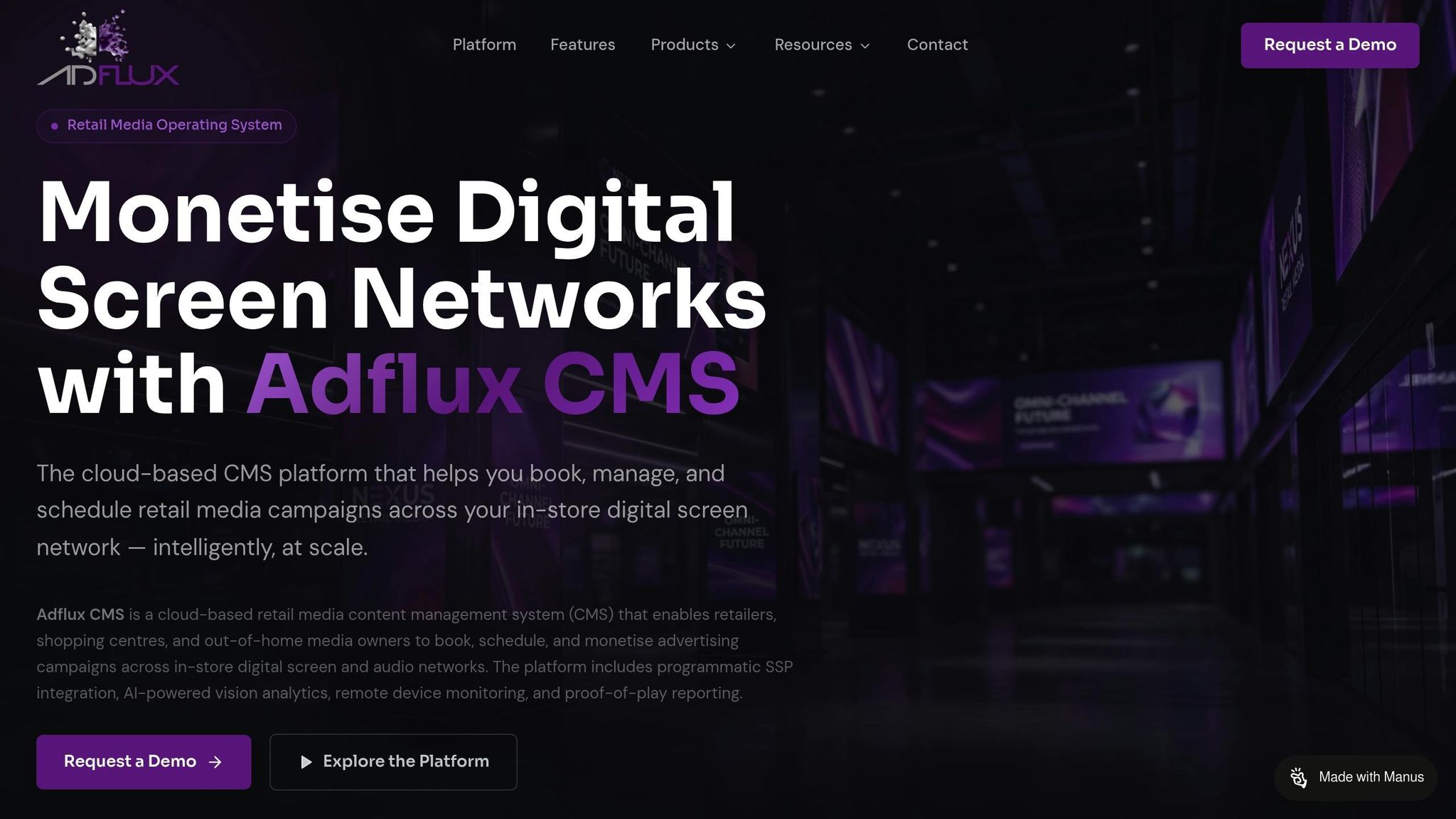
Adflux CMS is designed with enterprise-level governance in mind, offering features that address common challenges. For instance, its multi-user access system allows you to assign specific permission levels, ensuring only authorised personnel can make changes. If roles shift, access can be revoked instantly, reducing the risk of unauthorised edits that might violate brand guidelines or compliance requirements.
The platform’s API integrations work seamlessly with inventory databases, updating in real time. This means digital signage only advertises products that are actually in stock, avoiding misleading promotions that could lead to customer dissatisfaction or regulatory issues. Advanced scheduling tools let teams plan content well ahead of time, while screen grouping ensures that regional offers are displayed in the right locations.
Adflux CMS also excels in accountability. With proof-of-play reporting, advertisers can verify their campaigns ran as scheduled. Remote monitoring even provides the last image displayed on each screen and its operational status, offering clear evidence to resolve any disputes. This isn’t just about maintaining transparency - it’s about safeguarding revenue by building trust with advertisers.
Additionally, the platform’s privacy-focused analytics and centralised control simplify campaign management across hundreds of locations. This prevents the fragmented oversight that often leads to governance breakdowns, making it a critical tool for scaling operations effectively.
With tools like these, the next step is crafting a solid governance implementation plan.
Creating a Governance Implementation Plan
Building a governance framework requires careful planning and a structured approach. Start by auditing your digital assets - this includes advertising spaces, customer data, and marketing tools. First-party data should be cleaned and organised to ensure it can be activated across different platforms and campaign types. Without this groundwork, enforcing governance becomes a challenge.
Securing buy-in from leadership early on is crucial. Aligning C-level executives ensures access to resources and helps integrate marketing, CRM, and trade planning functions. A strong business case can make all the difference - highlight objectives, outline revenue streams, and show how the network enhances customer experience. With profit margins for mature retail media networks sitting at 60–70%, leadership is more likely to commit.
Next, focus on technology integration. Evaluate your existing tech stack - ecommerce platforms, CRM systems, customer data platforms, and analytics tools - to ensure they’re compatible with new advertising technologies. Platforms like Adflux CMS can connect systems such as POS and CRM, creating unified customer views while maintaining strict access controls.
Begin with a pilot phase involving 5–10 vendor partners. Offering discounted rates in exchange for feedback helps fine-tune technical performance and measure return on ad spend. This was the approach taken by 7-Eleven when launching its retail media network in March 2023, engaging 40 vendors and completing 20 campaigns that generated over $2 million in sales. A pilot phase validates the framework before scaling up.
Finally, establish clear measurement and reporting standards. Define KPIs like ROAS, incrementality, and sales uplift. Use playback reporting to give advertisers data on when and where their content was displayed. Regular audits, conducted quarterly, ensure that AI and automation stay aligned with evolving brand standards and regulations. As the global retail media market edges towards $168 billion by 2027, networks with the strongest governance strategies will be best positioned to thrive.
Governance Models in Retail Media Networks
Building on the core principles of governance, these models showcase how compliance and operational efficiency can be effectively achieved within retail media networks.
Case Study: Improving Compliance and Content Quality
Real-world examples highlight how governance frameworks can drive measurable improvements. In January 2026, Coles 360 became the first Australian retail media network to complete the IAB Australia Retail Media Certification Program audit. This independent review evaluates measurement practices against established industry standards, providing verified performance metrics. Tiffany Chen, General Manager, underscored its importance:
"Measurement plays an increasingly critical role in retail media... This certification is an important step toward creating industry-wide standardisation and strengthening accountability."
The certification process involves a detailed assessment of attribution methods, data management, and reporting accuracy. Once certified, retailers earn a badge valid for two years, signalling advertisers that the network adheres to professional standards. These certification initiatives help bridge trust gaps in data sharing.
Globally, Tesco Media in the UK demonstrated the potential of governance in delivering advanced campaigns. In May 2025, Tesco used data from its 23 million Clubcard members to execute a Cadbury 200-year anniversary campaign. This included in-store digital screens and offsite collaborations with Meta and Pinterest, alongside full-store wraps and digital activations. The campaign resulted in an 80% year-over-year increase in Cadbury sales.
These examples highlight the measurable benefits governance can bring, setting the foundation for assessing its broader business impact.
Measuring Business Impact
Governance frameworks deliver clear financial and operational benefits. For instance, a Fortune 50 retailer with nearly 200 million members introduced automated privacy controls between 2024 and 2025 to support its retail media network. By automating consent management across 150 million profiles and billions of transactions, the company ensured data integrity, supporting annual advertising revenue projections of $3–10 billion.
Additionally, strong governance practices can significantly reduce manual workload. On average, retailers save two hours per employee each week by eliminating manual data corrections and troubleshooting inconsistent product information. In 2025, the UK digital bank Tide slashed the time needed for manual PII tagging across 100 schemas from 50 days to just five hours by deploying automated governance playbooks.
David Jones provided another compelling example through its "David Jones Amplify" platform. By tracking SKU-level sales attribution, the retailer found that shoppers exposed to both onsite and offsite retail media were five times more likely to convert than those exposed to just one channel. This kind of closed-loop measurement - directly linking ad exposure to sales - has been identified as highly effective by 71% of retailers for demonstrating ROI.
As the Australian retail media market is forecast to reach $3 billion by 2027, networks capable of showcasing incrementality through robust governance are well-positioned to secure a larger share of advertiser budgets.
Conclusion
From compliance to data security and operational efficiency, enterprise-grade governance stands as the backbone of successful retail media networks. With Australia's retail media ad spend forecasted to hit $3 billion by 2027, networks that prioritise governance as a core element - rather than an afterthought - are poised to attract a greater share of advertiser investment.
The numbers paint a clear picture: implementing enterprise-grade governance can increase online conversion rates by 20–50% and save employees up to two hours per week. On the flip side, poor data quality can cost retailers an average of $13 million annually. A turning point came with Coles 360's February 2026 IAB Australia Retail Media Certification, which established a new standard for industry accountability.
As Daniel Lim from Louder aptly put it:
In 2026, the best-performing advertisers won't be the most aggressive. They'll be the most governed.
Automation has the power to amplify both successes and shortcomings. By embedding enterprise-grade governance into their operations, networks can ensure that automated systems enhance strengths rather than magnify errors across campaigns.
FAQs
Where do I start with enterprise-grade governance in a retail media network?
To get started, establish a well-defined governance framework that prioritises compliance, efficiency, and the ability to grow. This involves creating organisational policies, assigning clear roles, and setting standards for handling data, managing content, and overseeing programmatic advertising.
A solid data governance strategy is essential. Focus on maintaining data accuracy, ensuring security, and achieving consistency across systems. Incorporate recognised industry standards, such as IAB Australia’s principles for transparency, to guide your approach. Additionally, perform a thorough audit, outline key performance indicators (KPIs), and assign governance roles to support seamless scaling efforts.
How do we prove ROAS and incrementality without breaking privacy rules?
Proving ROAS (Return on Ad Spend) and measuring incrementality while respecting privacy requires adopting privacy-conscious measurement methods. One effective approach is running test-and-control experiments. In these tests, one group is exposed to the campaign, while a comparable group isn't. This setup allows marketers to assess the actual incremental impact of their advertising without relying on personal data.
Another key strategy involves using anonymised and aggregated data alongside advanced statistical models. These methods not only align with privacy regulations but also provide a reliable way to evaluate campaign performance and pinpoint the effect of advertising efforts.
Which teams should own governance, and what should be automated?
Enterprise-grade governance in retail media relies on collaboration across multiple departments, such as marketing, data management, compliance, and IT. These groups work together to create frameworks and policies that not only align with the company’s objectives but also comply with relevant regulations.
Automation plays a central role in this process. Tasks like data validation, compliance monitoring, content approvals, and reporting can all be streamlined through automated systems. This approach boosts efficiency, minimises errors, and makes it easier to manage expanding retail media networks at scale.
Adflux Editorial
Retail media, programmatic DOOH, and digital signage insights for Australian retailers.
Ready to build your retail media network?
Talk to the Adflux team about how the platform can work for your screens.