
Retail Media Network Management: Complete Guide for 2026
Retailers are turning commerce into high‑margin media channels that link ads to sales using first‑party data, AI and omnichannel measurement.
Retail Media Network Management: Complete Guide for 2026
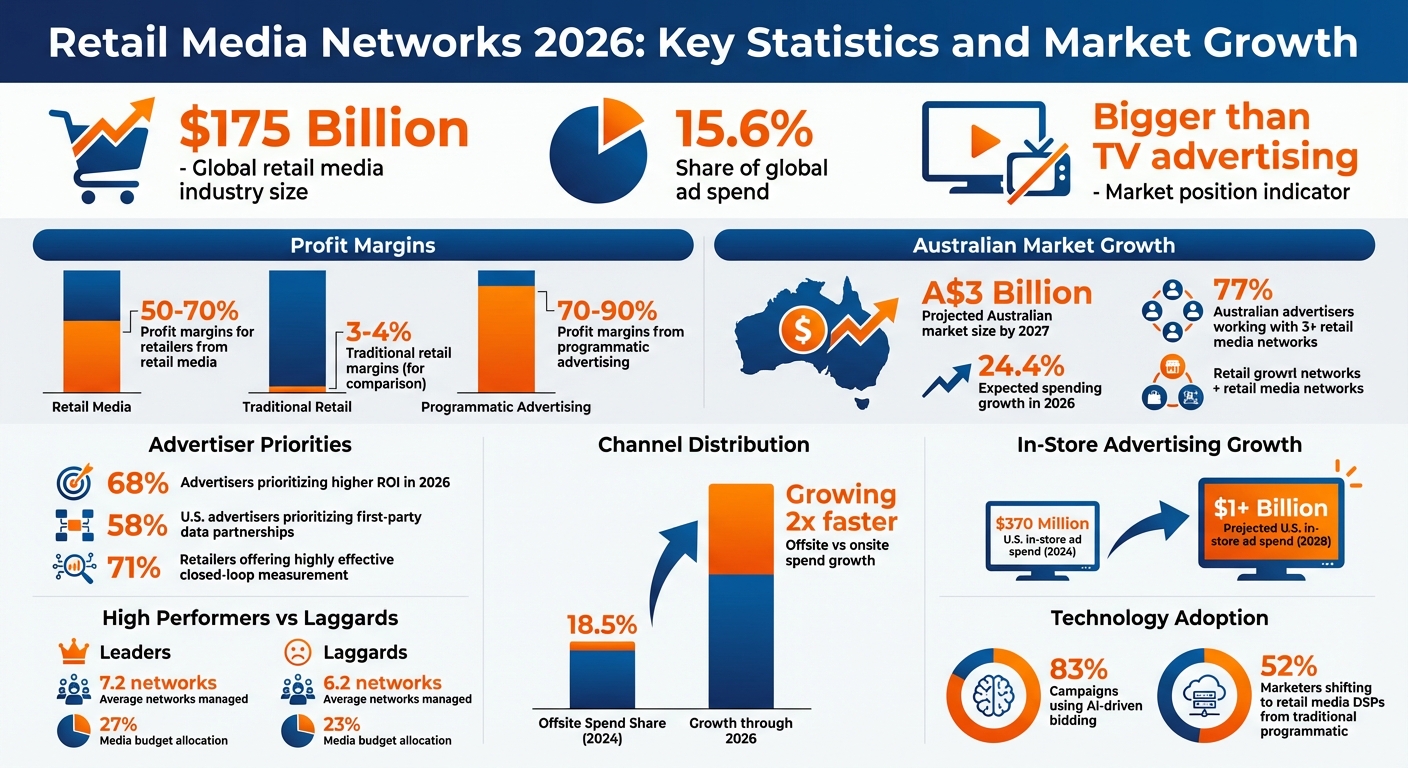
Retail media is now a $175 billion industry, making up 15.6% of global ad spend in 2026. It’s bigger than TV advertising and growing fast. Retailers are turning websites, apps, and even physical stores into ad platforms, offering brands precise targeting through first-party data. This shift delivers profit margins of 50–70% for retailers and allows brands to link ads directly to sales with closed-loop attribution.
Key trends shaping retail media in 2026 include:
- Programmatic advertising: Extends retailer data to social media, Connected TV, and the open web.
- In-store advertising: Digital screens, shelf labels, and checkout displays are turning physical stores into ad spaces.
- Omnichannel integration: Unifies customer data across online and offline channels for better measurement and targeting.
Retailers like Woolworths and Coles in Australia are leading the way, while brands are prioritising networks that offer measurable results. With AI-driven tools, programmatic platforms, and closed-loop measurement, retail media is becoming a central part of advertising strategies.
This guide explains how to design effective retail media strategies, optimise campaigns, and prepare for trends like AI and connected TV. Whether you’re just starting or managing multiple networks, this is your roadmap to success.
Retail Media Networks 2026: Key Statistics and Market Growth
Retail Media Roundtable with Zitcha - How to Build an Omnichannel Retail Media Network from Scratch
sbb-itb-c231c83
What Are Retail Media Networks?
A retail media network is an advertising platform run by a retailer that uses its own first-party data and inventory - like websites, apps, and physical stores - to help third-party brands connect with customers. Unlike traditional digital platforms that rely on browsing habits or inferred interests, these networks draw on actual purchase data, blending commerce with media to target consumers right at the moment they’re ready to buy.
One of the biggest advantages is closed-loop attribution. This means retailers can directly link ad impressions to verified sales, whether online or in-store, using loyalty programs and point-of-sale data. No wonder 58% of U.S. advertisers now prioritise partnerships that leverage first-party data for this reason.
"Retail media now sits where intent is highest - closer to the basket than almost any channel - and it finally links exposure to sales with closed‐loop attribution."
- Sarah Moss, AdTech Specialist
In Australia, the potential is massive. The retail media market is projected to reach A$3 billion by 2027, with spending expected to grow by 24.4% in 2026 alone. Major players like Woolworths (Cartology), Coles (Coles 360), Endeavour Group (MixIn), and Wesfarmers are already seeing profit margins between 50% and 70%. This shift transforms retailers into media companies, creating lucrative revenue streams without stepping away from their core business.
Here’s how it works: retailers offer advertising spaces (both digital and physical), brands pay to access these spaces using the retailer’s first-party data, and both benefit from measurable results directly tied to sales. With 77% of Australian advertisers now working with three or more retail media networks, understanding these platforms is becoming essential for navigating the evolving retail landscape.
Types of Retail Media Channels
Retail media networks operate across three main channels:
Onsite channels
These include sponsored search results, display banners, and native ads on the retailer’s website or app. These placements target shoppers at the "digital shelf", where purchase intent is highest. Key metrics include product page views, return on ad spend (ROAS), and add-to-cart rates.
Offsite channels
These extend the retailer’s first-party data to platforms like social media, connected TV, and the open web. Instead of waiting for customers to visit their site, retailers use purchase history and loyalty data to target shoppers wherever they are online. This approach significantly broadens reach - offsite retail media accounted for 18.5% of all U.S. retail media spend in 2024 and is expected to grow at double the rate of onsite spend through 2026. For example, Walmart teamed up with Disney in early 2024, allowing advertisers to use Walmart’s audience data to place targeted ads on Disney’s streaming services. Results were tracked through data "clean rooms" to measure ad effectiveness.
In-store channels
Physical retail spaces are becoming advertising opportunities through digital endcaps, electronic shelf labels, checkout screens, and in-store audio. U.S. in-store retail media spend is predicted to jump from $370 million in 2024 to over $1 billion by 2028. These placements influence shoppers directly at the shelf, with key metrics like store traffic and units sold per location.
| Channel Type | Primary Objective | Typical Placements | Core KPIs |
|---|---|---|---|
| Onsite | Win the digital shelf | Sponsored search, display banners, native ads | Page views, ROAS, add-to-cart |
| Offsite | Expand reach with retail data | Social media, CTV, open web ads | Reach, VTR, iROAS |
| In-store | Engage at the physical shelf | Digital screens, audio, checkout screens | Store lift, units per store |
In Australia, Endeavour Group (MixIn) partnered with Criteo in early 2026 to power its onsite retail media offerings. This collaboration uses AI-driven media and analytics to enhance omnichannel efforts, connecting digital ad exposures to verified in-store sales. Platforms like Amperity help align media strategies with commerce goals.
Benefits of Retail Media Networks
For retailers, the financial rewards are undeniable. Retail media advertising delivers profit margins of 50% to 70%, turning low-margin retail operations into high-margin media ventures. Globally, 71% of retailers say their networks are highly effective at providing closed-loop measurement for brands.
"Retail media has become the goose that's laying the golden eggs of modern retail."
- Troy Townsend, Zitcha
Brands also gain a major advantage: precise targeting. Instead of relying on inferred interests, retail media networks use real purchase data to connect with customers who are already showing buying intent. This is especially valuable in Australia, where 77% of advertisers and agencies now collaborate with multiple retail media networks. As third-party cookies phase out, first-party data ensures compliance and reliability, replacing vague metrics with solid sales results. Australian retailers are integrating data from e-commerce, loyalty programs, and point-of-sale systems into unified identity platforms, allowing for faster and more accurate audience targeting.
"Retail media's next chapter in Australia will be defined by flexibility, openness and smarter connections across the ecosystem."
- Guillaume Dupont, Head of Monetisation of Retail Media, Criteo ANZ
When done right, retail media networks can also improve the shopping experience. Personalised product suggestions and relevant sponsored ads can make the journey more enjoyable - so long as retailers manage ad placements carefully to avoid overwhelming customers.
Creating a Retail Media Network Strategy
Crafting a retail media network strategy in 2026 means tying your advertising efforts directly to measurable business outcomes. With retail media now making up 29% of all digital advertising spend, there’s no room for guesswork. The most successful organisations start by evaluating their current setup and setting clear goals that align with revenue growth, customer retention, and market share expansion.
"The gap between retail media leaders and laggards isn't about budget alone. It's about capability maturity, strategic clarity, and the willingness to move beyond what's comfortable."
- Russ Dieringer, Founder & CEO, Stratably
High-performing organisations typically operate across an average of 7.2 networks and allocate 27% of their media budgets to retail media. In contrast, lagging companies manage 6.2 networks and dedicate only 23% of their budgets. However, simply investing in more platforms won’t guarantee success. A strong strategy starts with understanding where you stand today and setting benchmarks for where you need to go. Begin with a detailed audit of your current retail media assets to lay a solid foundation.
Auditing Your Current Retail Media Setup
Before scaling your retail media operations, take stock of what you already have. Create a detailed inventory of all advertising spaces under your control. This includes onsite placements like sponsored search and display banners, offsite channels such as social media and connected TV, and in-store assets like digital endcaps and checkout screens. For each asset, document its technical specifications, usage rates, and management details. At the same time, map out your data sources, including point-of-sale systems, CRM platforms, e-commerce databases, loyalty programs, and third-party integrations like Instacart or DoorDash.
Poor data quality can have a big impact, with organisations losing an average of 31% in revenue due to bad data. Check your records for duplicates, missing fields (e.g., opt-in timestamps), and inconsistencies across channels. In industries like grocery retail, replacing one lost customer can require gaining 2.5 to 3.5 new ones, making data-driven retention strategies essential.
Your technology stack is another critical area to examine. Ensure your CDP, CRM, and analytics platforms support modern, automated functionalities. Managing campaigns across multiple networks with outdated or fragmented tools can slow progress. For instance, Endeavour Group partnered with Criteo in early 2026 to integrate AI-driven analytics into its "MixIn" platform, enabling it to connect digital ad exposures with verified in-store transactions. Such unified systems are becoming essential.
Compliance and security should also be part of your audit. By 2026, businesses must meet CCPA cybersecurity requirements, which cover 18 components like multifactor authentication and incident response. Ensure that consent requests are separate from terms of service and include timestamps for audit trails. With 73% of consumers prioritising privacy in loyalty programs, failing to meet these standards could damage both compliance and trust.
Lastly, evaluate how well your teams are aligned. Are merchandising, media buying, and other departments working toward shared goals? Can you measure incrementality and perform closed-loop attribution, or are you limited to basic ROAS reporting? Leaders in the field are often 1–2 years ahead in these capabilities.
"Measurement is shifting from backward looking validation exercise to a strategic capability - one that enables better investment decisions, stronger competitiveness, and more sustainable long-term growth."
- Guillaume Dupont, Head of Retail Media Monetisation, Criteo ANZ
| Audit Area | What to Evaluate | Why It Matters |
|---|---|---|
| Inventory | Digital and physical ad placements | Identifies monetisation opportunities and gaps |
| Data Quality | Duplicates, missing fields, format consistency | Poor data can cost 31% in lost revenue |
| Tech Stack | Real-time sync, AI automation, cross-platform support | Fragmented tools slow execution and limit scale |
| Compliance | CCPA requirements, consent timestamps, security protocols | Non-compliance risks fines and erodes trust |
| Organisational Alignment | Silo review, measurement maturity | Disconnected teams limit strategic impact |
Setting Goals and KPIs
Once your audit is complete, use the findings to set measurable goals. Your objectives should focus on boosting revenue, improving retention, and increasing market share. These goals should directly address the gaps identified during your audit.
Instead of relying solely on last-click conversions, track KPIs that capture the entire customer journey. Key metrics include ROAS, iROAS, and sales uplift. Growth indicators like new-to-brand and new-to-category buyers are also critical, as are business impact measures such as incremental revenue, profitability, basket lift, and units per store. Engagement metrics like product detail page views, add-to-cart rates, viewable impressions, and click-through rates provide additional insights.
"The era of let's test and see is long gone. In 2026, retail media is being measured, compared, and budgeted against other serious media channels."
- Osmos
Focus on incrementality from the outset. Start with your largest investments - such as major platforms like Woolworths and Coles in Australia - and expand your measurement efforts gradually. Use control versus exposed group testing to isolate the sales directly driven by your ads. This focus on incrementality is what sets leaders apart.
Rather than comparing all efforts to a single platform, set benchmarks at the category level. For mid-sized retail media networks, aim for an ad mix of 58% product ads and 42% display ads, with 75% of product ad spend flowing through AI-led auto-bidding. Hero categories should target 5–10% ad revenue relative to gross merchandise value (GMV), while growing and emerging brands should contribute 30–40% of total revenue.
| KPI Category | Specific Metrics to Track | 2026 Success Benchmark |
|---|---|---|
| Performance | ROAS, iROAS, Sales Uplift, Conversion Rate | 75%+ of spend on AI auto-bid |
| Growth | New to Brand, New to Category, Market Share | 30–40% revenue from emerging brands |
| Business Impact | Incremental Revenue, Profitability, Basket Lift | 5–10% ad revenue to GMV for hero categories |
| Engagement | PDP Views, Add-to-Cart, Viewable Impressions, CTR | 7+ active networks for leaders |
Finally, ensure all teams are aligned on these goals. In 2026, Australian retailers are increasingly synchronising merchandising, media, and shopper experience objectives. When everyone is working toward shared outcomes, your retail media network becomes a cohesive, strategic asset instead of a fragmented revenue stream.
Technology for Retail Media Network Management
The technology stack you choose plays a massive role in determining whether your retail media network thrives or struggles with operational headaches. By 2026, success will depend on integrated platforms that can handle content, analytics, and monetisation in one seamless system. Retailers are moving away from fragmented tools and adopting solutions that manage everything from screen scheduling to programmatic auctions under a single umbrella.
"In 2026, growth doesn't come from launching another network. It comes from making it easier for brands to spend confidently across the ones that matter."
- AdButler
With retail media now accounting for 15.6% of global ad spend and U.S. in-store ad spend projected to jump from $370 million in 2024 to over $1 billion by 2028, the operational stakes are higher than ever. Leading Australian retailers like Endeavour Group are already using AI-powered analytics to link digital ad exposures to in-store purchases. The technology you invest in today will either enable this level of sophistication or hold you back. Below, we explore how Adflux CMS supports advanced capabilities like centralised content management, AI analytics, and programmatic advertising.
Centralised Content Management and Scheduling
An effective retail media network needs a robust CMS to manage content across multiple locations. Without a centralised system, overseeing hundreds - or even thousands - of digital screens becomes a logistical nightmare. Adflux CMS solves this by providing a single interface for managing nationwide digital signage campaigns, ensuring consistent messaging across all stores. From any web browser, teams can upload, update, and monitor content remotely, avoiding the inefficiencies of manual updates.
Automation is where these platforms shine. Adflux CMS uses real-time data to auto-generate content - product details, pricing, images - and assign campaigns to screens without manual input. Its API integrations enable dynamic updates based on factors like inventory levels, ensuring you’re not promoting out-of-stock products.
Another standout feature is screen grouping. You can organise screens by region or store type, making it easy to push tailored promotions. For example, a Queensland grocery chain could promote tropical fruits in warmer areas while running a different campaign in cooler southern regions - all from the same dashboard.
The platform also supports multi-user access with custom permission levels. Marketing teams can schedule campaigns, while store managers monitor playback status using "Screen Health" features, which show the last image displayed on each screen. This remote monitoring ensures campaigns are running as planned without requiring on-site checks.
Advanced scheduling tools allow teams to plan weeks or even months of content in one session, reducing daily workloads. With "set-and-forget" scheduling, campaigns run automatically, freeing up teams to focus on strategy. For brands and agencies, self-service portals offer the flexibility to manage campaigns independently, further easing the burden on retail teams.
| Feature | Operational Benefit |
|---|---|
| Centralised CMS | Manage nationwide screen networks from one platform |
| Content Automation | Real-time updates for pricing and availability |
| Remote Health Checks | Monitor playback status and connectivity remotely |
| Programmatic SSP | Automate ad sales to maximise revenue |
| API Integration | Trigger dynamic content updates based on external data |
AI-Powered Analytics and Reporting
AI-driven analytics are transforming retail media by shifting the focus from reactive validation to proactive strategy. Predictive modelling tools analyse massive datasets to forecast consumer behaviour based on browsing and purchase patterns. Advanced machine learning algorithms also optimise budget allocation in real-time bidding (RTB) environments, ensuring maximum ROI.
Closed-loop attribution is another game-changer. It connects ad impressions directly to both online and in-store transactions, delivering metrics like return on ad spend (ROAS) and incremental ROAS. This allows retailers to measure performance across the entire customer journey, from initial exposure to final purchase.
"True incrementality means measuring more than what is immediately obvious. It requires capturing lift across the full funnel, from early exposure through to purchase."
- Guillaume Dupont, Head of Retail Media Monetisation, Criteo ANZ
Unified measurement is critical for effective decision-making. By consolidating data into a single view, teams can compare performance across on-site, off-site, and in-store channels without being misled by short-term trends.
AI-powered vision analytics add yet another layer of insight. Adflux CMS includes privacy-first tools that track shopper attention metrics while maintaining privacy compliance. These features provide proof-of-play reporting, showing which ads were displayed and how long shoppers engaged with them. This data feeds directly into campaign optimisation, creating a cycle of continuous improvement.
Programmatic Advertising and Monetisation
Programmatic advertising is revolutionising how retailers monetise their media inventory. Real-Time Bidding (RTB) auctions allow brands to purchase ad space across e-commerce sites, apps, and in-store digital channels with unparalleled precision. By automating inventory sales, retailers can achieve profit margins of 70–90%, far exceeding the 3–4% margins typical in traditional retail.
By 2026, retail media is expected to account for over 25% of global digital ad spend. Off-site retail media, which uses first-party data to target shoppers on platforms like social media and Connected TV, is projected to make up 18.7% of U.S. retail media ad spend by 2026. This highlights the growing importance of programmatic capabilities.
A strong programmatic tech stack includes a Supply-Side Platform (SSP) for managing inventory, an ad exchange, and a bid engine for facilitating sales. Adflux CMS integrates these components to centralise programmatic ad management across in-store digital screens, ensuring campaigns run smoothly across all touchpoints. Its SSP integration automates processes to maximise revenue.
Programmatic tools also give advertisers more control. For instance, brands can use their own Demand-Side Platform (DSP) seats, like The Trade Desk, to activate retailer audiences while maintaining transparency over inventory supply and pricing.
"The advertiser's goal is to achieve the best return on ad spend (ROAS), and the way to achieve this goal is by media agencies and advertisers practicing transactional transparency."
- Stephen Dwyer, Senior Director, Partner Solutions Group, Roundel (Target)
"While traditional retail margins typically hover between 3–4%, retail media advertising can deliver margins up to 70–90%."
- Sal Trifilio, Sr. Corporate Marketing Manager, Mirakl
To maximise revenue, offer multiple buying options: direct sales for premium placements, self-service portals for partners who want control, and open programmatic marketplaces for automated inventory fill. Use tools like Customer Data Platforms (CDPs) and Data Clean Rooms to securely activate purchase-based signals for off-site targeting, ensuring both precision and compliance with privacy laws.
Improving Campaign Performance
Once you have a solid tech setup and strategic framework, the next step is fine-tuning your campaigns to deliver better results. By 2026, the gap between successful networks and those that fall behind will come down to how effectively campaigns are optimised. With 83% of retail media campaigns now leveraging AI-driven bidding, advertisers demand more than vanity metrics - they want clear evidence that their investment drives incremental sales.
Three key practices drive success: audience segmentation, personalised creative at scale, and real-time campaign refinement. These strategies, supported by tools like unified content management and AI analytics, lead to measurable outcomes.
Audience Segmentation Methods
Not every customer is equally valuable or persuadable. Effective segmentation focuses on the "movable middle" - customers who can be nudged into converting - rather than loyal buyers or those unlikely to engage. By 2026, advanced networks will use real-time data to create micro-segments that adapt dynamically.
- RFM Segmentation (Recency, Frequency, Monetary): This approach targets customers based on behaviour rather than demographics. For example, "Champions" (high scores across all dimensions) might receive VIP offers, while "At-Risk" customers (low recent activity) are ideal for win-back campaigns.
- Intent-Based Segmentation: This method identifies shoppers in the research phase by analysing purchase signals like search queries or browsing patterns. It’s particularly effective for targeting "in-aisle" shoppers who haven’t committed to a brand yet.
- Lookalike and Custom Audiences: Using first-party data, machine learning identifies new audiences that share traits with your high-value customers.
- Behavioural Segmentation: Tracking actions like "AddToCart" or "ViewContent" helps predict future intent and target users accordingly.
To avoid overwhelming algorithms, start with 3–5 audience groups. Combining psychographics (e.g., eco-conscious values) with behavioural data can further refine targeting and ensure alignment between stated beliefs and actual purchases.
| Funnel Stage | Retail Media Role | Key Segmentation/Tactics |
|---|---|---|
| Awareness | Reach new users | Lifestyle targeting, Streaming TV ads, broad demographics |
| Consideration | Target "in-aisle" shoppers | In-market segments, generic/category search, competitor audiences |
| Conversion | Drive immediate sales | Retargeting (cart abandoners), branded keywords, DCO |
| Loyalty | Ensure repeat purchase | RFM "Champions", Subscribe & Save messaging, replenishment ads |
Dynamic Creative Optimisation (DCO)
Once high-value audience segments are identified, delivering tailored ads becomes the next priority. Static ads are falling behind, while Dynamic Creative Optimisation (DCO) takes personalisation to the next level. By using real-time data - like location, browsing habits, or inventory levels - DCO automatically adjusts ad elements such as headlines, images, and calls-to-action. For instance, it might show abandoned cart items with a discount to retargeted users or highlight bestsellers for new visitors.
The results speak for themselves. DCO ads achieve a 150% higher click-through rate, with campaigns seeing a 67% boost in ROAS and conversion rates. Additionally, cost per acquisition can drop by 30%. These improvements can make the difference between a campaign that thrives and one that wastes resources.
DCO also bridges the gap between onsite retail media (like sponsored search) and offsite channels (such as social media or CTV). This allows for sequential messaging that adapts to a user’s journey - whether they’re in the awareness stage or ready to purchase. Multivariate testing at scale is another advantage, enabling algorithms to identify the most effective creative combinations for different segments.
"Dynamic Creative Optimization is no longer optional for performance marketers. The ability to automatically personalise ads at scale delivers significant performance improvements while reducing creative production burden."
- AdBid
To get started, provide at least 5+ headlines, 5+ images, and 3+ CTAs. This gives the DCO platform enough material to generate effective combinations. Regularly audit product feeds to ensure accurate pricing, high-quality images, and up-to-date inventory. Always test DCO against static ads to measure its added value before expanding to more complex setups.
Focus on search-native display formats like search tiles or inline banners. These placements outperform standard homepage banners by 31%, making them a smart choice for display budgets.
Ongoing Campaign Refinement
Campaign optimisation isn’t a one-time task - it’s an ongoing process. Performance should be reviewed at specific intervals: days 1–2 for early indicators, week 1 for stabilisation, and week 2 for identifying repeatable patterns. This approach helps avoid knee-jerk reactions to short-term fluctuations while addressing genuine performance issues promptly.
Incrementality testing is essential. Move beyond last-click attribution by using holdouts, geo-splits, or time-based pauses to measure how much sales are directly influenced by ads versus organic demand. Allocate 5–10% of your budget for testing new ad types and platform updates to stay ahead of trends.
"The goal isn't statistical perfection; it's informed decision-making."
- Matthew Hurle, Head Of Activation, Brands & Agencies, Criteo
Centralise fragmented data from different platforms into a single repository for consistent comparisons of ROAS and total spend. Standardise naming conventions and metrics to ensure clarity across platforms (e.g., "Total Sales" versus "Gross Merchandise Value"). This unified view helps manage cross-channel frequency, reducing ad fatigue and overexposure.
Don’t rely solely on ROAS. Include metrics like brand lift (awareness, consideration) and attention data (dwell time, eye-tracking) to assess long-term impact. Regularly audit high-margin SKUs to ensure they’re prioritised during peak shopping periods.
Leverage predictive analytics to anticipate performance trends and adjust budgets before campaigns conclude. Tools like Adflux CMS integrate AI-powered analytics into this process, offering detailed reporting that supports continuous improvement. These refinements feed into a cycle of optimisation, ensuring campaigns stay effective over time.
Measuring Success and Attribution
Running campaigns is only part of the equation; proving their effectiveness is what sets successful networks apart from those that drain budgets. By 2026, 68% of advertisers will prioritise higher ROI over other channels when deciding to increase retail media budgets. To measure ROI accurately, it’s essential to move beyond surface metrics and focus on proving causality rather than simple correlation.
The challenge lies in tracing a shopper's journey across multiple touchpoints. For example, a customer might see a sponsored product ad on their phone, research it later on a laptop, and then make the purchase in-store days later. Without proper attribution, these sales could be wrongly credited to organic demand. Closed-loop measurement addresses this issue, and 71% of retailers already consider their networks highly effective at tracking the full customer journey. This approach ties measurement directly to campaign refinement and optimisation.
Key Performance Metrics
To truly evaluate campaign success, focusing on metrics that show causality is critical. While Return on Ad Spend (ROAS) remains a popular metric - calculated by dividing total ad revenue by total ad spend - it has its limitations. ROAS doesn't prove that an ad caused the sale. Instead, Incremental ROAS (iROAS) isolates revenue generated solely by the ad, offering a more accurate picture of campaign impact. As Pacvue explains:
"High ROAS does not always signal real growth. Branded search often captures existing intent, inflating results without adding incremental demand".
iROAS requires controlled tests, comparing sales from an exposed group to a holdout group, and dividing the incremental revenue by ad spend.
Another key metric is Blended Customer Acquisition Cost (CAC), which provides a comprehensive view of efficiency by combining online and offline marketing spend and dividing it by total new customers. Companies using Blended CAC data make 24% better budget allocation decisions than those who measure channels separately. A sustainable CAC to Lifetime Value (LTV) ratio is typically 1:3.
Brand impact metrics also play a role. Retail media campaigns in 2025–2026 have shown a +2-point improvement in brand image and a +4-point increase in purchase intent compared to other media channels. Metrics like dwell time, interaction rates, and ad recall (up +3 points) help assess the creative effectiveness of campaigns beyond just sales.
For advanced networks, SKU-level attribution has become indispensable. Instead of relying on brand-level data, linking ad spend directly to individual product sales offers more granular insights. In 2025, Wolt Ads (part of DoorDash) implemented SKU-level tracking across 29 markets, resulting in a 32% revenue increase, a 4× ROAS, and a 148% category share boost for an ice cream brand. As Catalina Salazar, Head of Wolt Ads, highlighted:
"We had a really easy way to offer custom, bespoke audiences, and we could measure everything easily within the same platform. That end-to-end experience, along with the results, proves that this truly delivers value for our partners".
These detailed metrics enable strategic adjustments that align with broader campaign goals.
| Metric Type | Key KPI | Calculation / Purpose |
|---|---|---|
| Efficiency | ROAS | Total Ad Revenue / Total Ad Spend |
| Causality | iROAS | Incremental Revenue / Total Ad Spend |
| Acquisition | Blended CAC | Total Marketing Spend (Online + Offline) / New Customers |
| Retention | LTV | Avg. Order Value × Purchase Frequency × Customer Lifespan |
| Brand | Ad Recall | Percentage of audience that remembers the ad |
Another critical metric is Weeks of Cover, which ensures ads are only active when stock levels can meet the projected lift in demand. In 2025, Panasonic used this approach to redirect ad spend during high-potential moments, nearly doubling total sales and achieving an 83% lift in new-to-brand revenue.
Closed-Loop Attribution
Closed-loop attribution is the backbone of effective campaign measurement, connecting ad impressions to final purchases - whether online or in-store. This process involves five steps: activating campaigns, capturing data through persistent identifiers (like shopper IDs or loyalty programme data), integrating data via clean rooms or customer platforms, mapping attribution across touchpoints, and generating actionable insights through dashboards.
Data Clean Rooms play a pivotal role in ensuring privacy during this process. Platforms like Amazon Marketing Cloud (AMC) allow brands to analyse pseudonymised shopper data, linking ad exposure to purchases without compromising consumer privacy.
Currently, 70% of retailers struggle to fully connect online campaigns to in-store sales, leading to 20–35% of marketing budgets being wasted due to inaccurate attribution. To address this, some retailers have started integrating Point-of-Sale (POS) systems with digital media data, using tools like Bluetooth beacons, Wi-Fi analytics, and computer vision to track foot traffic and dwell time.
For example, Sam's Club implemented closed-loop attribution on its Member Access Platform in 2025, enabling suppliers to track both online and offline sales for a complete view of the customer journey. Similarly, a leading beverage brand used "Dynamic Dayparting" on Amazon to adjust bids based on hourly conversion patterns, boosting revenue by 31% across multiple product lines.
To implement closed-loop attribution effectively, retailers should prioritise first-party data from loyalty programmes and hashed emails, ensuring compliance with privacy laws like GDPR and CCPA. Incrementality tests - comparing exposed groups to control groups - help isolate campaign impact, with results validated using lift percentages and p-values. Monitoring "Retail Readiness" by activating ads only when products are in stock and winning the "Buy Box" further prevents wasted spend.
With 90% of shoppers using smartphones in-store, mobile apps provide a critical link between online ads and physical store sales. Features like unique discount codes, QR codes, or geofencing can track interactions and connect them to purchases. Looking ahead, 70% of companies plan to invest in AI-driven attribution platforms to handle multi-channel data more effectively.
As Sarah Moss from AI Digital explains:
"The defining advantage of retail media is closed-loop measurement. Retailers can directly connect ad impressions to actual transactions using their customer data".
Future Trends in Retail Media Network Management
The future of retail media network management is being shaped by a shift toward integrated systems that link every customer interaction. By 2027, the U.S. retail media market is expected to hit US$105 billion, driven by networks that treat retail media as a central data hub rather than an isolated channel. Two major forces are driving this transformation: the blending of online and offline experiences and the rise of AI systems capable of autonomous decision-making. These changes are setting the stage for smarter, more cohesive campaign management.
Omnichannel Integration
Retail media is expanding far beyond traditional sponsored product listings on e-commerce platforms. Brands are now allocating 30% of their paid search budgets and 34% of their paid social budgets to drive traffic to retailer sites instead of their own. This reflects a broader trend where retail media data fuels campaigns across social platforms, Connected TV (CTV), and even physical stores, creating a more unified customer experience.
For example, in 2024, Walmart partnered with Disney to allow advertisers to target Walmart's audience segments on Disney's streaming services. Sales impact was measured through data clean rooms. Similarly, Instacart teamed up with Roku to enable brands to link CTV ad views directly to grocery purchases. In Australia, Endeavour Group collaborated with Criteo in 2026 to enhance its retail media offerings with AI-driven tools for omnichannel execution.
Physical stores are also becoming prime media spaces. U.S. in-store retail media ad spend is forecast to grow from US$0.37 billion in 2024 to over US$1.0 billion by 2028. Digital end-caps, smart-cart displays, and checkout screen ads now offer dynamic pricing and real-time creative updates, transforming store aisles into valuable advertising inventory. As these in-store networks gain traction, they are expected to claim a larger share of national advertising budgets.
However, for retailers to fully capitalise on these opportunities, breaking down organisational silos is essential. Media and commerce teams must work together to ensure retail media data informs broader cross-channel strategies rather than existing as a separate budget line. Unified commerce platforms that integrate order management, point-of-sale (POS), and inventory systems in real time are becoming critical. As Raghav Sibal, Vice President, APAC at Manhattan Associates, puts it:
"The ability to make intelligent decisions in the moment, where orders are placed, changed or fulfilled, will shape competitive advantage in 2026".
This seamless channel integration naturally leads to the advanced analytics transforming campaign management.
AI and Predictive Analytics
AI is evolving from basic automation to systems capable of managing entire advertising operations autonomously. These systems handle everything from campaign lifecycles to multi-retailer strategies and real-time bid optimisation. AI is also making a mark in creative production, campaign management, and analytics, with each area accounting for roughly 42% of current AI use.
Predictive analytics is another game-changer, enabling ads to act as helpful nudges rather than interruptions. By leveraging deep first-party data, networks can suggest products based on real-time customer intent - like recommending a specific ingredient for a recipe someone is browsing. Colin Lewis, a Retail Media Expert, highlights this shift:
"AI is now both a 'layer' of capability being added to Retail Media and a 'lens' through which propositions are being developed and sold - and agentic commerce is promising to be the biggest layer".
Retail media DSPs (Demand-Side Platforms) are also gaining ground, replacing traditional programmatic platforms by offering verified purchase behaviour instead of relying on proxy signals. 52% of marketers expect this transition to continue. Megan Conahan, EVP of eCommerce at Direct Agents, explains:
"Retail media DSPs are winning not because they're cheaper, but because they replace proxy signals with verified purchase behaviour and attribution marketers can actually defend".
Another emerging trend is the integration of social media creators directly into retail campaigns. This approach connects influencers with shoppable moments, like recipe bundles or loyalty offers. CJ Pendleton, Chief Strategy Officer at Matrixx, underscores the importance of this shift:
"The big 2026 unlock is 'creator-to-retailer' systemisation... Social Commerce won't scale until brands stop treating it as a separate channel... and start building systems that connect creators and content directly to shoppable retail programmes".
To keep up with these advancements, networks should prioritise tools like data clean rooms for secure audience matching and incrementality measurement in a privacy-focused environment. Real-time tools for budget adjustments are becoming standard. Platforms such as Adflux CMS are stepping up with AI-driven analytics, programmatic SSP integration, and real-time reporting, helping networks stay agile in a fast-changing marketplace.
Conclusion
Retail media has become a critical part of the advertising landscape. By 2026, success will hinge on creating scalable systems that deliver consistent value across multiple channels. With global retail media spending surpassing $175 billion and making up 15.6% of total ad spend, networks that embed retail media into their core operations will attract the largest share of advertiser budgets.
The shift toward first-party data is reshaping how marketers allocate their budgets. A striking 52% of marketers are redirecting investments from traditional programmatic platforms to retail media DSPs. Why? Because these platforms provide verified purchase data instead of relying on proxy signals. However, this advantage is only fully realised when networks unify their technology, seamlessly connecting online, offline, and Connected TV channels. As Jaclyn Nix, Chief Operating Officer at Kevel, puts it:
"2026 is the year retail media grows up. The experimentation era is over. What remains is an opportunity for brands and retailers to combine creativity, technology, and data into campaigns that are measurable, scalable, and meaningful".
Beyond leveraging data, precise measurement is the next big challenge. Incrementality measurement, which focuses on true sales lift rather than basic ROAS, is becoming the gold standard. Top-performing brands, which dedicate 27% of their total media budgets to retail media and manage an average of 7.2 networks, succeed because they can demonstrate tangible business impact. For networks, adopting unified measurement tools is no longer optional - it’s essential.
Physical stores are also evolving, integrating digital advertising into the in-store experience. At the same time, AI-powered bidding has taken centre stage, with 83% of campaigns now relying on automated optimisation. Networks that combine these advancements with transparent and reliable AI systems will not only gain advertiser trust but also foster lasting partnerships. These innovations are paving the way for a new chapter in retail media. Tools like Adflux CMS are already enabling this transformation by offering centralised management solutions that work seamlessly across formats and channels.
FAQs
How do I start a retail media network audit?
To kick off a retail media network audit, start by examining your digital and physical assets. This includes looking at website traffic, customer data, and in-store digital displays to pinpoint areas where monetisation is possible. Next, dive into your advertising operations by reviewing key metrics such as ad revenue, engagement rates, and attribution data.
Take a close look at your technology stack to confirm it can handle scalable, data-driven advertising efforts. Lastly, establish clear benchmarks that align with industry standards and reflect Australian retail trends. These benchmarks will serve as a roadmap for fine-tuning your strategy.
What’s the difference between ROAS and iROAS?
ROAS (Return on Ad Spend) is a metric that looks at the total revenue generated from your ads compared to how much you spent on them. It’s a straightforward way to measure the overall efficiency of an ad campaign.
On the other hand, iROAS (incremental Return on Ad Spend) digs deeper. It focuses solely on incremental revenue - the sales that happened purely because of your ads. These are purchases that wouldn’t have occurred without the advertising effort.
This makes iROAS a sharper tool for evaluating how much your ads are truly contributing to growth, cutting through the noise to reveal their direct impact.
How can I prove in-store ads drove sales?
To understand how in-store ads impact sales, leverage store analytics to track consumer behaviour and purchasing trends. Tools such as traffic analytics, shopper journey insights, and occupancy data can help identify the connection between ad exposure and sales outcomes. By comparing sales figures during advertising periods to baseline data, you can measure the difference. Additionally, analysing shopper paths and their engagement with digital screens offers further insight into how ads shape buying decisions. This method delivers clear, data-backed results.
Adflux Editorial
Retail media, programmatic DOOH, and digital signage insights for Australian retailers.
Ready to build your retail media network?
Talk to the Adflux team about how the platform can work for your screens.