
Top 8 Features Every Retail Media Platform Needs in 2026
Eight must-have capabilities for retail media platforms in 2026: AI optimisation, programmatic SSPs, privacy-first vision analytics, RTB, proof-of-play, omnichannel integration and governance.
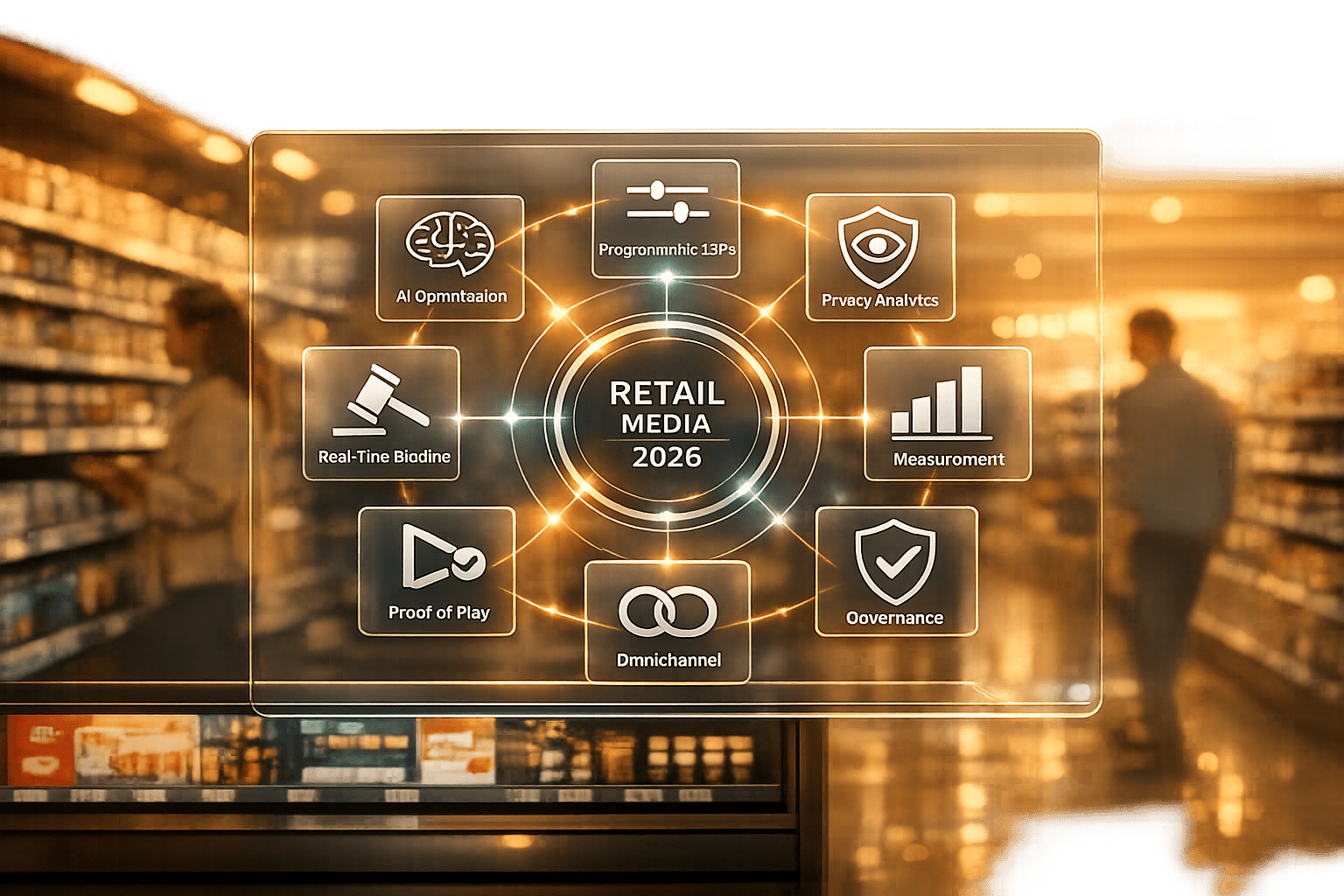
Top 8 Features Every Retail Media Platform Needs in 2026
Retail media platforms in 2026 must evolve to meet growing expectations from advertisers, retailers, and consumers. With Australian retail media spending projected to grow by 24.4% this year and outpace TV ad revenue by 2027, platforms that fail to adapt risk falling behind. Here are the eight must-have features for success:
- AI-Powered Campaign Optimisation: Automates bidding, reduces inefficiencies, and scales campaigns while protecting consumer data through privacy-first AI.
- Programmatic SSP Integration: Connects retail media networks to broader ad ecosystems, enabling automated ad buying and real-time auctions.
- Privacy-First Vision Analytics: Collects anonymised in-store shopper data, linking physical and digital experiences without compromising privacy.
- Real-Time RTB Auction Engine: Ensures lightning-fast ad placements with dynamic pricing, crucial for handling large-scale operations.
- Advanced Proof-of-Play Reporting: Verifies ad impressions in real time, providing reliable performance data for advertisers.
- In-Store and Omnichannel Integration: Links digital ads to verified in-store sales, creating a unified customer experience across all channels.
- Dynamic Content Scheduling and Playlists: Automates ad updates based on inventory and demographics, ensuring relevance and efficiency.
- Enterprise-Grade Governance and Brand Safety: Implements strict controls for ad placements, ensuring accountability and protecting brand reputation.
Retailers like Bunnings, Commonwealth Bank, and Endeavour Group are already leveraging these features to connect digital and in-store campaigns, proving the importance of integrated, privacy-compliant systems. Platforms must prioritise measurable outcomes, trust, and efficiency to thrive in this booming market.
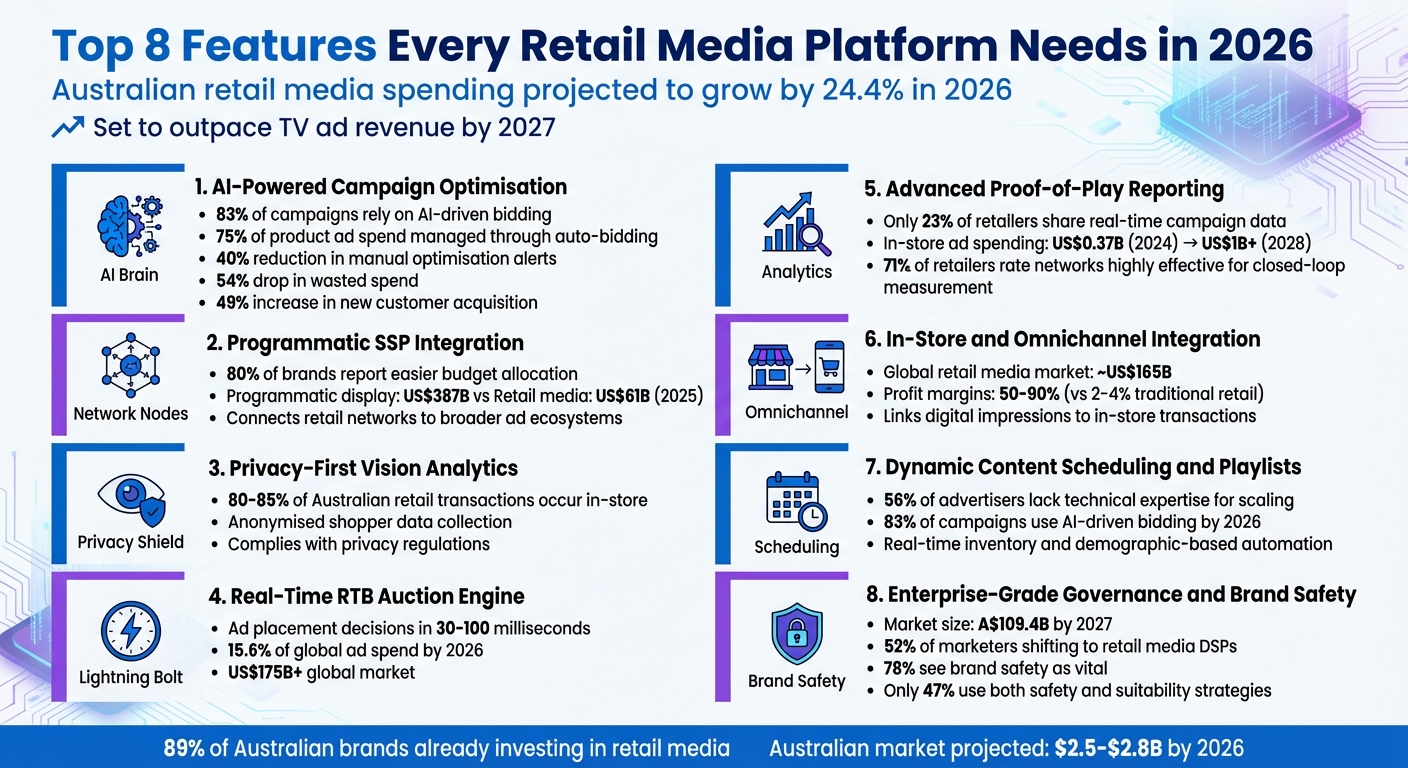
8 Essential Features Every Retail Media Platform Needs in 2026
Retail Media Mastery: 15 Years, 15 Lessons, 15 Minutes
sbb-itb-c231c83
1. AI-Powered Campaign Optimisation
Artificial intelligence has transitioned from being a luxury feature to becoming the backbone of retail media platforms in 2026. At present, 83% of campaigns rely on AI-driven bidding, with 75% of product ad spend managed through auto-bidding. While AI doesn’t replace human strategy, it eliminates inefficiencies and allows campaigns to scale seamlessly.
The challenge for brands is undeniable: they are juggling an average of eight different retail media networks, a trend expected to persist through late 2026. Manual bidding simply can’t keep up with this complexity. AI steps in by adjusting bids in real-time and preventing budget depletion, reducing manual optimisation alerts by 40%.
As Joshua Dreller from Kenshoo Skai explains: "The brands pulling ahead aren't working harder. They built different operational capabilities".
This shift is laying the groundwork for large-scale, enterprise-level growth.
Scaling for Enterprise Needs
For enterprises, scaling operations without adding more staff is critical. AI-led diagnostics automatically detect issues such as missed SKU coverage, underbidding, or budget limitations. Brands leveraging AI for incrementality have seen a 54% drop in wasted spend and a 49% increase in new customer acquisition, although only 12% have integrated media and commerce functions.
Scalability aside, AI platforms must also prioritise consumer data protection while delivering actionable insights.
Privacy-First Analytics
As AI expands its role, safeguarding consumer data becomes essential. Privacy-first AI is no longer optional. Modern platforms employ data clean rooms to securely match brand and retailer data, enabling precise incrementality measurements without exposing sensitive information. For example, in September 2025, Danone collaborated with a retail media network using a secure data clean room. By combining their data with the retailer's first-party insights in a privacy-compliant way, they achieved measurable sales growth without compromising customer trust. Instead of relying on third-party cookies, AI analyses first-party commerce signals like search trends, purchase history, and loyalty data.
Bridging Digital and In-Store Experiences
AI also closes the gap between digital ad exposure and in-store purchases, completing the customer journey. In early 2026, Amazon expanded its AI-powered shopping assistant, Rufus, to connect shopper identities across online and in-store purchases. This allowed for hyper-personalised recommendations based on a unified view of customer behaviour.
Guillaume Dupont from Criteo ANZ observes: "In 2026, Australian retailers are increasingly working to harmonise merchandising, media and experience goals".
2. Programmatic SSP Integration
By 2026, retail media platforms can no longer afford to operate as isolated "walled gardens." The integration of Programmatic Supply-Side Platforms (SSPs) connects retail media networks to a broader advertising ecosystem, enabling automated ad buying and selling through real-time auctions. This shift is pivotal: 80% of brands and agencies report that programmatic purchasing makes it easier to allocate budgets to commerce media.
In 2025, programmatic display advertising hit a staggering US$387 billion, far outpacing retail media's US$61 billion. By embracing SSPs, retailers can access national brand budgets flowing through Demand-Side Platforms (DSPs), moving beyond the confines of smaller shopper marketing budgets. For Australian retailers, this means competing directly with traditional publishers for media dollars while leveraging a unique edge - verified purchase behaviour. This evolution aligns with the AI-driven strategies outlined earlier.
Scalability for Enterprise Use
Enterprise retailers, especially those with extensive in-store digital assets, benefit significantly from automation. Programmatic SSPs simplify operations by automating trafficking and order adjustments, reducing the workload for internal teams [25, 11]. For example, in early 2025, Criteo partnered with ADvendio to enhance automation and transparency in sponsored product campaigns. This partnership provided a centralised view of inventory and revenue across on-site, off-site, and in-store channels [25, 27].
Sherry Smith, President of Retail Media at Criteo, remarked, "Our integration with ADvendio brings new levels of automation and transparency to Sponsored Product campaigns, helping retailers deliver more efficient operations and stronger outcomes for their brand partners".
Real-time budget syncing prevents overspending, while competitive auctions ensure optimal yield, making these solutions indispensable for large-scale operations.
Privacy-Compliant Analytics Capabilities
Modern SSPs prioritise privacy by relying on first-party data and authenticated environments. Data clean rooms play a key role, securely matching audiences without exposing raw customer records [12, 20, 24, 30]. A notable example from 2024 is Walmart's partnership with Disney, which allowed advertisers to use Walmart's first-party audience segments for programmatic ads on Disney's streaming platforms. Data clean rooms were then used to measure the direct sales impact.
By early 2025, 66% of organisations had adopted data clean rooms for first-party data collaboration. The industry is also moving towards standardised frameworks like PAIR (Provider-Agnostic Identifier for Resurfacing) and ADMaP (Attribution Data Matching Protocol) to ensure seamless interoperability between retail media networks and SSPs.
Omnichannel and In-Store Compatibility
SSPs are bridging the gap between digital and physical retail spaces, unifying inventory under a single operating system. In early 2026, Australian retailer Endeavour Group partnered with Criteo to enhance its on-site and omnichannel retail media capabilities. This integration linked digital ad exposures with verified in-store transactions, offering closed-loop attribution - a key advantage over traditional advertising.
In-store retail media ad spending in the U.S. is forecasted to grow from approximately US$370 million in 2024 to over US$1 billion by 2028. Programmatic SSPs enable Media Sales Automation, opening in-store assets like digital endcaps, audio, and checkout screens to global programmatic marketplaces.
Megan Conahan, EVP of eCommerce at Direct Agents, explained, "Retail media DSPs are winning not because they're cheaper, but because they replace proxy signals with verified purchase behaviour and attribution marketers can actually defend".
3. Privacy-First Vision Analytics
Even in an increasingly digital world, a staggering 80–85% of Australian retail transactions still take place in physical stores. This makes collecting in-store audience data not just useful but essential. Privacy-first vision analytics step in here with advanced AI-driven computer vision and sensor technology. These tools complement AI-powered campaigns by gathering shopper data - like age, gender, and group composition - while ensuring individual identities remain anonymous.
A standout example of this technology in action happened in February 2026 when Walmart Connect Mexico teamed up with Swiss tech firm Advertima. Together, they launched what they called the "world's largest in-store audience intelligence rollout." Thousands of sensors were installed across hundreds of stores to capture anonymised shopper data in real time, enabling more targeted advertising.
Jonatan Fasano, Business Development Director at Walmart Connect Mexico, noted: "When we looked at how in-store retail media needs to evolve, it was clear that the same principles must apply inside the physical store as well".
Privacy-Compliant Analytics Capabilities
These systems achieve compliance by combining anonymised real-time signals with a retailer's first-party data and contextual insights. Instead of creating individual profiles, they focus on building audience segments. This approach aligns with Australian privacy laws, as it avoids storing personally identifiable information. Identity resolution technology ensures first-party data can be securely linked across platforms without compromising privacy.
The growing focus on accountability means these systems aren't just about data collection - they're about delivering measurable outcomes. For instance, in January 2026, Albertsons Media Collective introduced a new in-store incrementality measurement framework for a Mondelēz campaign. Vision analytics paired with digital screens allowed them to measure store-level impact, achieving a $2.41 matched-market incremental return on ad spend (iROAS) and a 14% boost in in-store sales across 116 locations. This kind of detailed analysis sets the stage for fully integrated omnichannel experiences.
Omnichannel and In-Store Compatibility
Vision analytics also play a key role in bridging the gap between physical stores and online platforms. While earlier AI-driven methods focused on optimising digital campaigns, vision analytics bring the missing offline data layer needed for a unified retail experience at scale.
A great example of this integration came in February 2026, when Coles 360 became the first Australian retail media network to partner with Snapchat's "Promoted Places." This feature allowed brands to run proximity-based ads that encouraged store visits. By linking ad engagement to in-store and online sales data, the platform provided clear ROI measurements.
This seamless blend of offline and online data is redefining how retailers approach customer engagement and advertising.
4. Real-Time RTB Auction Engine
Real-time bidding (RTB) technology is at the heart of today’s retail media platforms, enabling lightning-fast ad placement decisions and dynamic pricing in just 30–100 milliseconds. This level of speed is essential as retail media evolves into its "infrastructure era", where experimental budgets are being replaced by enterprise-level systems designed to handle massive scale. By 2026, retail media is projected to account for over 15.6% of global ad spend, amounting to a $175 billion+ global market. Without dependable RTB engines, platforms risk falling behind in this rapidly growing space.
The real strength of RTB lies in its ability to automate processes that once required manual effort. Instead of negotiating every ad placement individually, RTB engines use AI-powered algorithms to assess the value of each impression in real time, ensuring maximum revenue from both premium and leftover inventory [44, 24]. This level of automation not only boosts efficiency but also aligns seamlessly with AI-driven optimisation strategies. For Australian retailers juggling hundreds of physical stores alongside online operations, RTB engines streamline workloads while improving revenue outcomes.
Integration with Programmatic Advertising
RTB’s speed becomes even more impactful when integrated with programmatic advertising, creating a more expansive and connected ecosystem. These engines link a retailer’s Supply-Side Platform (SSP) with a variety of Demand-Side Platforms (DSPs), opening up inventory to a global network of advertisers. For instance, in early 2026, Kevel introduced a native Adobe Experience Platform (AEP) Destination, enabling retailers like Sonae and Currys to activate first-party audience segments in real time. This innovation turned static customer data into actionable insights.
The growing focus on programmatic integration is further highlighted by the rapid expansion of off-site retail media ad spend, which is expected to grow at twice the rate of on-site spend through 2026. Retailers are increasingly using DSPs to extend their first-party data to external platforms like Disney or Roku, powering shoppable Connected TV ads through real-time auction technology.
Megan Conahan, EVP of eCommerce at Direct Agents, explained: "Retail media DSPs are winning not because they're cheaper, but because they replace proxy signals with verified purchase behaviour and attribution marketers can actually defend".
Privacy-Compliant Analytics and Omnichannel Compatibility
Modern RTB engines are built with privacy in mind, relying on first-party data from retailers - such as loyalty programs and purchase histories - rather than third-party cookies. By using data clean rooms, they can measure incrementality without exposing personal information.
This privacy-first approach extends beyond online platforms to physical stores. Digital endcaps, in-store audio, and checkout screens are now treated as programmatic inventory alongside digital placements [12, 28]. For example, U.S. in-store retail media spending is expected to grow from $0.37 billion in 2024 to over $1.0 billion by 2028, with Australian retailers following similar trends. In early 2026, Endeavour Group (MixIn) partnered with Criteo and Amperity to enhance omnichannel strategies by linking digital retail media exposures to verified in-store transactions using AI-powered analytics. This closed-loop attribution method directly connects digital ads to in-store sales, outperforming traditional advertising approaches.
5. Advanced Proof-of-Play Reporting
Advanced proof-of-play reporting takes digital advertising to the next level by ensuring every ad impression is verified and measurable. This reporting method has become a key component of the industry's transition to infrastructure-grade systems. These systems confirm that ads appear on digital screens - whether at endcaps, checkout displays, or aisle screens - and provide advertisers with reliable performance data. For context, U.S. in-store retail media ad spending is expected to grow from about $0.37 billion in 2024 to over $1 billion by 2028.
Right now, only 23% of retailers share campaign data with advertisers in real time. Advanced proof-of-play systems help bridge this gap by automating the allocation of campaigns to specific screens and verifying their delivery in real time, significantly reducing manual effort. This is especially valuable as advertisers juggle campaigns across an average of six retail media networks today, a figure projected to nearly double to 11 by the end of 2026.
"Running six networks today and aiming for eight plus next year means more contracts, more formats, more reporting, and more internal confusion", said Enrico Babucci, Chief Strategy Officer at OmniShopper.
Scalability for Enterprise Use
Real-time verification is just the beginning. For enterprise-level networks, scalability requires standardised reporting across massive digital ecosystems. Retail media networks operating at this scale need centralised platforms to manage digital signage across thousands of locations while ensuring consistency and efficiency. Advanced proof-of-play systems provide unified metrics, eliminating the fragmented, network-specific reporting that often complicates operations.
With 83% of retail media campaigns expected to rely on AI-driven bidding by 2026, these systems must also include diagnostic tools to flag issues like underbidding or budget constraints before they affect campaign performance. However, only 15% of advertisers currently feel confident in their measurement practices, highlighting the need for better tools.
Integration with Programmatic Advertising and Privacy-Compliant Analytics
When proof-of-play reporting integrates seamlessly with programmatic platforms, it creates a closed-loop system that directly links verified ad impressions to actual transactions. This enables platforms to deliver actionable metrics like return on ad spend (ROAS) and incremental revenue by securely matching ad exposure data with purchase data. These insights align with the privacy-first approach discussed earlier, ensuring data security while offering meaningful results.
Privacy compliance is a cornerstone of these advanced systems. Data clean rooms allow retailers to connect ad exposure with purchase data without revealing personally identifiable information. By leveraging first-party data from loyalty programs and purchase histories, these platforms remain effective even as privacy regulations evolve. Impressively, 71% of retailers rate their networks as highly effective in conducting closed-loop measurement using these privacy-safe methods.
"Retail media networks that consistently prove incremental impact will outperform those that cannot, making outcome-driven measurement a prerequisite for brand investment", noted Jaclyn Nix, Chief Operating Officer at Kevel.
6. In-Store and Omnichannel Integration
Blending physical retail with digital channels has become a key focus for 2026, with the global retail media market projected to reach around $165 billion. Notably, ad sales in this space boast profit margins of 50% to 90%, far exceeding the slim 2%–4% margins typically seen in traditional product sales.
Today's advanced platforms rely on centralised content management systems to manage digital signage across thousands of locations. This ensures a unified message across both physical stores and digital platforms. Real-time point-of-sale integration takes it a step further, allowing ad-serving technology to tweak in-store creative dynamically based on stock availability or immediate sales feedback. This seamless connection drives the "online to in-store" journey, where online advertising directly influences in-store visits and purchases. These advancements are paving the way for new partnerships that are reshaping omnichannel experiences.
A great example of this is Australia's Endeavour Group, which in early 2026 teamed up with Criteo and Amperity to establish a retail media network. This network not only connects digital ad impressions with in-store transactions but also uses real-time AI analytics to elevate omnichannel strategies. As a result, 71% of retailers now rate their networks as highly effective in achieving closed-loop measurement.
"Retailers across Australia are reaching a tipping point where they simply cannot meet customer expectations with legacy systems. The ability to make intelligent decisions in the moment... will shape competitive advantage in 2026", said Raghav Sibal, Vice President, APAC, Manhattan Associates.
These collaborations are driving a shift in the industry. Platforms are consolidating all media channels into single, streamlined dashboards. This evolution moves beyond trial phases, creating robust systems that link digital ad impressions with verified in-store transactions using first-party loyalty data. The result? A clearer, more complete view of the customer journey. In the U.S., in-store retail media ad spending is forecast to grow from $0.37 billion in 2024 to over $1.0 billion by 2028, underscoring the growing demand for integrated solutions.
7. Dynamic Content Scheduling and Playlists
Automated scheduling systems have become a game-changer for managing retail media at scale. By leveraging real-time data - like inventory levels, local demographics, and pricing signals - these systems eliminate the hassle of manual adjustments. They place ads exactly where and when they’re needed, streamlining operations.
Why does this matter? Retail media networks are increasingly fragmented. Automated scheduling bridges this gap by syncing ad content with live data. For example, when a product sells out, the system instantly updates creatives across all platforms, ensuring customers see relevant ads while protecting ad budgets from being wasted on unavailable products. This approach allows for scalable and unified management across networks.
Scalability for Enterprise Use
For large-scale operations, managing fragmented retail media networks can overwhelm internal teams. In fact, 56% of advertisers say their biggest challenge in scaling retail media efforts is a lack of technical expertise. Automation helps by taking over repetitive tasks like bid adjustments, pacing, and content updates, freeing up team capacity.
"The administrative overhead of managing a fragmented RMN portfolio is a real cost that rarely shows up in media budgets but absolutely affects team capacity and speed of execution", says Joshua Dreller, Sr. Director, Content Marketing at Skai.
Centralised platforms simplify this process further by enabling enterprises to manage campaigns across multiple networks from a single dashboard. For in-store campaigns, these systems assign ads to specific screens based on criteria like location and audience demographics, all without manual intervention.
Integration with Programmatic Advertising
The rise of programmatic advertising has reshaped retail media. By 2026, 83% of retail media campaigns will use AI-driven bidding, with 75% of ad spend flowing through automated systems. These systems need to process data - like purchase history and real-time product availability - in milliseconds to deliver ads at the perfect moment.
In Australia, quick-commerce platforms are already integrating with programmatic exchanges like The Trade Desk. This allows for 10-minute feedback loops and API-first infrastructure, making auction-based bidding and personalised targeting highly efficient.
Privacy-Compliant Analytics Capabilities
Privacy concerns are a growing challenge, but scheduling platforms are stepping up with data clean rooms. These tools allow businesses to match audiences and activate first-party data without exposing sensitive information. This ensures compliance with cookieless privacy standards while enabling precise targeting.
Permission-based tracking is another key feature. It provides accurate insights into cross-device shopping behaviours, helping refine omnichannel strategies without relying on third-party cookies. With only 15% of advertisers confident in their retail media measurements due to fragmentation, unified privacy-compliant analytics are becoming a must-have.
Omnichannel and In-Store Compatibility
Dynamic scheduling ensures a consistent experience across all customer touchpoints. Whether someone is shopping through a mobile app, browsing a website, or looking at an in-store digital screen, the promotions and product availability stay aligned. This is especially crucial as off-site retail media grows at twice the rate of on-site channels. Orchestration platforms sync data across social, web, and in-store channels, creating a seamless customer journey.
A standout example of this is Albertsons Media Collective’s January 2026 campaign for Mondelēz. By combining in-store digital screens with on-site and off-site media, and comparing 116 banner locations to non-advertising stores, the campaign delivered a $2.41 matched-market iROAS and a 14% lift in in-store sales.
"The ability to make intelligent decisions in the moment, where orders are placed, changed or fulfilled, will shape competitive advantage in 2026", says Raghav Sibal, Vice President, APAC, Manhattan Associates.
8. Enterprise-Grade Governance and Brand Safety
With retail media projected to grow into a massive A$109.4 billion market by 2027, protecting brand reputation has become a top priority. While earlier sections explored advanced analytics and privacy-focused strategies, governance and brand safety are the final pieces of the retail media platform puzzle. To thrive, platforms must implement systems that prevent ads from appearing in unsuitable contexts, all while maintaining the flexibility needed for large-scale operations. As retail media transitions from experimental budgets to a core part of marketing infrastructures, centralised buying, pacing, and governance using established ad-tech frameworks are now essential. This expanding market not only demands innovation but also governance solutions that can handle enterprise-level complexity.
Scalability for Enterprise Use
Managing dozens of fragmented retail media networks can be a logistical headache. To address this, large organisations are moving towards centralised platforms that streamline execution and standardise reporting. These systems require features like role-based permissions, audit logs, and strict controls over ad placements. This ensures ads don’t disrupt user experiences or harm brand reputations. Additionally, global blacklists and whitelists must be consistently managed across thousands of placements.
AI plays a big role here, with algorithms flagging suspicious click-through rates to detect fraud. Platforms are also adopting "explainable AI", which provides transparency into performance metrics instead of relying solely on black-box automation.
"In 2026, the question isn't: 'How many advertisers can we onboard?' It's: 'How easily can advertisers operate at scale?' That's where infrastructure - not point solutions - becomes the differentiator."
– AdButler Editorial
Integration with Programmatic Advertising
Scalable governance also extends to programmatic advertising. By shifting budgets from open exchanges to private marketplaces (PMPs), retailers can better control where ads appear, ensuring they only run on vetted, high-quality publisher sites. Tools like Ads.txt help verify the legitimacy of programmatic purchases.
Third-party verification tools - such as Integral Ad Science (IAS), DoubleVerify, and Moat - add another layer of accountability by enabling ad blocking and auditing viewability. This shift is reflected in the fact that 52% of marketers are reallocating budgets away from open-web DSPs in favour of retail media DSPs, which offer more reliable purchase data.
"Retail media DSPs are winning not because they're cheaper, but because they replace proxy signals with verified purchase behaviour and attribution marketers can actually defend."
– Megan Conahan, EVP of eCommerce at Direct Agents
In February 2026, Coles 360 became the first Australian retail media network to complete the IAB Australia Retail Media Certification Program audit. Led by General Manager Tiffany Chen, this initiative provides an independent review of measurement practices to enhance accountability and give brands greater confidence in reported results.
"Measurement plays an increasingly critical role in retail media... This certification is an important step towards creating industry-wide standardisation and strengthening accountability", Chen explains.
Privacy-Compliant Analytics Capabilities
Privacy concerns have driven the adoption of data clean rooms, which allow brands to securely match their data with retailer first-party data without exposing sensitive information. Edge AI has also emerged as a key tool, processing data locally - whether on-device or in-store - to minimise transmission risks and protect sensitive information. Additionally, synthetic data pipelines allow platforms to simulate personalised experiences without using real customer data. These tools are proving effective, with 71% of retailers rating their networks as highly capable of closed-loop measurement.
Omnichannel and In-Store Compatibility
Brand safety isn’t just a digital concern - it extends to all media environments, including Connected TV (CTV), social media, and in-store digital screens, such as endcaps and checkout displays. Consistent governance across these touchpoints is essential to protect brand reputation while enabling the scale required for enterprise operations.
Platforms must differentiate between brand safety, which focuses on avoiding harmful content, and brand suitability, which ensures ads appear in environments aligned with a brand’s values. While 78% of industry experts see brand safety as vital for digital campaigns, only 47% currently use both safety and suitability strategies. Meanwhile, blacklists and whitelists need constant updates to adapt to emerging risks.
With retail media accounting for 29% of all digital advertising spend in 2026, enterprise-grade governance and robust brand safety measures have become critical for staying competitive.
Conclusion
Australia's retail media market is projected to grow to $2.5–$2.8 billion by 2026. To succeed in this competitive space, platforms need to rely on smart, unified infrastructure. The eight key features discussed earlier provide a roadmap for addressing fragmentation and achieving measurable, compliant growth. These include AI-powered campaign optimisation, programmatic SSP integration, privacy-first vision analytics, real-time RTB auction engines, advanced proof-of-play reporting, in-store and omnichannel integration, dynamic content scheduling, and enterprise-grade governance.
By adopting these capabilities, retailers can shift their focus from just increasing revenue to improving contribution margins, tracking both media profitability and retail sales uplift. With 89% of Australian brands already investing in retail media, there’s growing demand for streamlined and unified buying experiences. Retailers are under pressure to accelerate audience activation, cutting campaign turnaround times from weeks to hours, while also linking digital ad exposures to verified in-store transactions. Additionally, prioritising first-party data intelligence ensures compliance with tightening data protection laws.
"Retail media is not just a new revenue stream, it's a new operating discipline. The retailers who treat it that way will build enduring growth."
– Jack Byrne, CEO APAC, Zitcha
Looking ahead, AI-driven shopping assistants may revolutionise product discovery by responding to real-time intent rather than static keyword bidding. Some platforms are already achieving profit margins of 50–70%, proving how the right infrastructure can turn retail media into a scalable and sustainable business model. The certification milestone achieved by Coles 360 highlights how Australian retailers are setting the standard for accountable and privacy-compliant retail media ecosystems. These strategic advancements are positioning Australian retailers to thrive in an ever-changing market.
FAQs
How do I prove in-store ads drove sales?
To show that in-store ads directly contribute to sales, use closed-loop measurement systems. These systems connect ad exposure to actual purchases by integrating data from in-store screens, point-of-sale (POS) systems, and loyalty programs. By doing this, you can attribute specific sales to particular ads.
Analytics tools play a key role here, helping to link customer interactions with ads to their transactions. Regularly reviewing this data can provide insights into ad performance. Just make sure all data collection strictly adheres to privacy regulations - this not only ensures compliance but also reinforces the credibility of your sales impact analysis.
What’s needed to sell in-store screens programmatically?
Retailers looking to sell in-store screens through programmatic advertising need a combination of advanced tools and smart technology. Key elements include AI-powered analytics, seamless connectivity with in-store digital displays, and a data-driven platform like Adflux CMS. These features make it possible to target customers in real-time and measure campaign performance effectively, ensuring marketing efforts align closely with customer behaviours.
How can we use AI without breaching privacy laws?
To integrate AI into your operations while adhering to privacy laws, it's essential to prioritise strategies that respect user privacy. Start by working with anonymised or aggregated data rather than handling personally identifiable information (PII). Tools like data clean rooms allow for secure data collaboration without exposing sensitive details.
Equally important is maintaining transparency with your audience. Clearly communicate how data is used, obtain explicit consent when necessary, and ensure compliance by using AI solutions built with privacy in mind. Techniques like differential privacy and federated learning can help protect individual data while still enabling effective analysis and targeting.
Adflux Editorial
Retail media, programmatic DOOH, and digital signage insights for Australian retailers.
Ready to build your retail media network?
Talk to the Adflux team about how the platform can work for your screens.